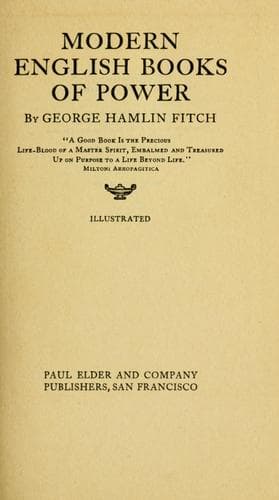
English literature -- 19th century -- History and criticism
In the same way Browning offends against this primal canon of art. A
man who was capable of writing the most melodious verse, as is shown
in some of his lyrics, he refused to put his thoughts in simple form,
and often clothed them in obscurity. The result is that the great
public which would have enjoyed his studies of character and his
powerful dramatic faculty is repelled at the outset by the
difficulties of understanding his poems. Browning added to this
obscurity by constant reference to little-known authors. This was not
pedantry, any more than Milton's use of classic mythology was
pedantry. Both men possessed unusual knowledge of rare books, and both
were much given to quoting authors who are unknown to the general
reading public.
But with all these difficulties in the way, there still remains a body
of verse in Browning's work which will richly repay any reader. The
lyrics and short poems like _The Pied Piper of Hamelin_, _Pippa
Passes_, _Prospice_, _O Lyric Love_, _The Last Ride_, _One Word More_,
_How They Brought the Good News_, _Herve Riel_, the epilogue to
_Asolando_, _The Lost Leader_, _Men and Women_, and _A Soul's Tragedy_
will give any reader a taste of the real Browning. If you like these
poems, then try the more ambitious poems like _A Blot in the
'Scutcheon_, _The Inn Album_, _Fifine at the Fair_ and others.
Browning, above all other English poets, seems to have had the power
of seizing upon a character at a crucial hour in life and laying bare
all the impulses that impel one to high achievement or great
self-sacrifice. He seems always to have worked at the highest
emotional stress, so that his words are surcharged with feeling. In
many of his poems this emotional element is painful in its intensity.
Character to him was the main feature, and his selections comprise
some of the most picturesque in all history. That he was able to make
these people live and move and impress us as real flesh-and-blood
human beings shows the great creative power of the man, who ought to
have written some of the world's finest plays.
Public-domain text, read in full here on John Shaqi.
Reviews
Reviews
No reviews yet
Be the first to share your thoughts on this work.
Elsewhere in the archive
Join the Discussion
Join the discussion
Sign in to leave a comment or review.
Sign InorCreate an account