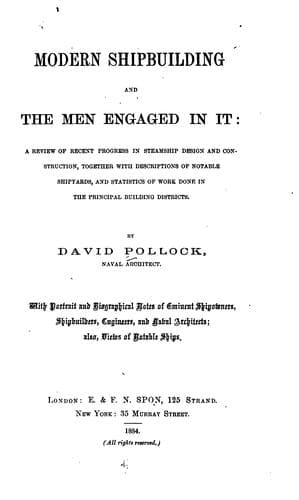
Modern shipbuilding and the men engaged in itPollock, David
History
Modern shipbuilding and the men engaged in it
Pollock, David
Shipbuilding -- Great Britain
The care and ingenuity expended on the question of ship safety must
not, however, be measured simply by the amount of attention and skill
exercised in constructing and outfitting vessels of the common type.
The question has very naturally occasioned many distinct novelties
in ship design. Some of these have been directly designed to secure
safety, but the greater number have aimed at combining with safety
the other qualities of speed and comfort; as in the instances given
in the previous chapter. The success attained in practice, it need
scarcely be said, has hitherto been but partial.
The problem of rendering ships absolutely unsinkable has, from very
early times, received attention from many concerned in shipbuilding
and navigation. Propositions and trials have been made from time to
time, without as yet any very marked success attending any of them.
Various plans have been submitted for safety-ships, the general
principle of which consists in forming the ship into two or more
distinct and entire portions, and in the event of one sustaining
damage by collision or otherwise, those remaining to be disconnected
and sent adrift—presumably with all passengers on board.
Other life-saving devices, while interfering somewhat with the
original structure, have simply been intended to use or modify
existing features or material on board ship. Two of these which have
received attention from the Scientific Societies may be shortly
described as examples of the class of devices referred to. One was
the proposition of Mr Jolly, M.A., of the Royal Navy, laid before
the Institution of Naval Architects in 1874; the other being that
of Mr Gadd, submitted to the Manchester Mechanical Society in 1879.
Mr Jolly’s proposal was to construct what he felicitously termed
the “ark saloon,” an erection on the upper deck, and resembling
very closely an ordinary deck-house, but instead of being built
permanently on the vessel, it was to be an independent structure
capable of being readily disconnected, and “while answering all the
purposes of accommodation found in ordinary deck-houses, to have
within it hidden resources capable of converting it when afloat
into a perfectly navigable vessel.” Mr Gadd’s proposal was to form
the upper portion of the bulwarks of ships of loose sections 12-ft.
long, composed chiefly of hollow, thin metallic tubes. These sections
when immersed in the water would form so many pontoons, and would be
provided with cords and loops along their sides, and in the event
of the ship going down would be lifted out of their place by the
action of the water. Objections on economical grounds to Mr Jolly’s
scheme, fully pointed out by members of the Institute, apply almost
equally to the proposal of Mr Gadd. The expense involved in their
application would far outbalance in the eyes of the shipowner the
possible service they could render. No provision was made by Mr Jolly
for launching his ark saloon, thereby limiting its use to cases of
Public-domain text, read in full here on John Shaqi.
Reviews
Reviews
No reviews yet
Be the first to share your thoughts on this work.
Elsewhere in the archive
Join the Discussion
Join the discussion
Sign in to leave a comment or review.
Sign InorCreate an account