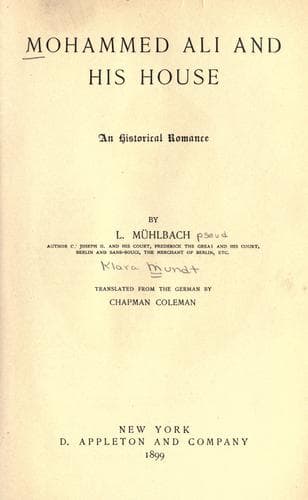
Egypt -- History -- Mohammed Ali, 1805-1849 -- Fiction; Muhammad Ali Basha, Governor of Egypt, 1769-1849 -- Fiction
"I hear you," murmured the stiffening lips. "And do I love you? Your
mother's love struggled with Death for a whole year. He tried to
drag me hence, and I struggled with him day after day, and night
after night. Love helped me to deceive you, or you would have seen
your mother dying day by day. Now, I am going hence, and the
agathodaemon will give me new garments, and a new countenance full
of youth and beauty, that your father may see me as I looked in the
days of our youthful love. O my son, may the woman you are to love
be not far distant; may she soon wing her flight to you, the dove of
innocence, with the countenance of love and the fragrance of the
rose? May she open heaven unto you with her star-like eyes? This is
my last blessing, my son. Allah watch over you! Farewell!"
The words were soft and low, like the whispering of a departing
spirit. Mohammed had listened eagerly, his ear held close to her
lips, and he still listened when the light of his mother's eyes was
extinguished, and the hand of Death had swept over her countenance,
imparting to the white brow a yellow, and to the lips a blue tint.
Suddenly he shuddered, raised his head and looked at his mother. He
then uttered a shriek, a loud, fearful shriek, that caused the
mourning-women outside to bound to their feet, for they knew that it
was thus that survivors shriek when Death seizes his prey.
They now commence their mournings, and farther off other cries and
lamentations are heard. The latter are uttered by the friends of
Ibrahim Aga. They have placed themselves near the but to begin,
according to a religious custom, the service of the dead, as soon as
the soul shall have left the body.
They form a circle near the open door. Their arms crossed over their
breasts, they stand there, moving their heads continually from one
side to the other. "Allah il Allah!" they cry, and within stand the
women shrieking, yelling, and lamenting, over the deceased. They at
last arouse Mohammed, who had swooned away beside the body. He
springs to his feet, pushes back the women, and bounds into the
middle of the circle of men, who whirl around faster and faster;
they suppose he has come to join in their ceremony, but he pushes
them aside and rushes forth. He rushes so rapidly up the pathway
that no one can follow him, and no one attempts to do so.
His grief must exhaust itself, they say to each other.
"When it has done so, and evening comes, he will return." The
evening came, but Mohammed had not returned to perform the sacred
duty of watching over the dead through the night, as it became an
only son to do. The mourning women had departed to rest after their
exertions. They now returned, the sheik having ordered that they
should perform the night-watch in the absence of the son, in order
that the ghins might not enter and pronounce their curse over the
house, condemning the future generations, descending from the dead,
to misery.
Public-domain text, read in full here on John Shaqi.
Reviews
Reviews
No reviews yet
Be the first to share your thoughts on this work.
Join the Discussion
Join the discussion
Sign in to leave a comment or review.
Sign InorCreate an account