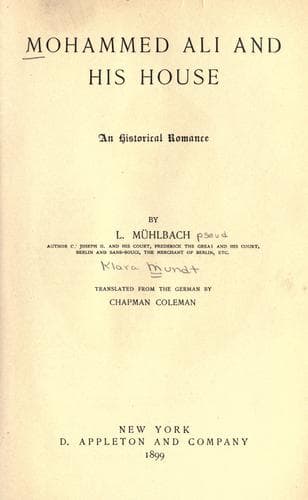
Egypt -- History -- Mohammed Ali, 1805-1849 -- Fiction; Muhammad Ali Basha, Governor of Egypt, 1769-1849 -- Fiction
"I will die--die " he suddenly cries out, and springs to his feet so
quickly that the serpents and lizards barely escape being trodden on
as they escape to their holes behind the rocks. "Here I will remain.
How often, in the past, have I longed to be in my cave, my only
secret, my only possession." Once, to gratify this longing, I came
here, and then turned back, and said to myself. He who cannot
practice self-denial, cannot enjoy! And now I have practiced it, and
yet I have not enjoyed. But now I will enjoy, will enjoy death, at
least. Yes, I am resolved," said he, with trembling lips." I will
remain here and enjoy death. What does this struggling from day to
day avail this dreaming of future glory? Each succeeding day is in
poverty and misery the same. I was a fool to dream of future glory.
Now I will die. Let others be happy! Let the slave, Osman Bey,
attain what the free Mohammed cannot attain. He is welcome to his
reward death is at the end of it all, for him, too!"
He looks, through the opening in the rock, at the heavens above him,
and then rises higher to look down at the sea also, as though he
wished to take leave of it in a last glance. He then lies down on
his mat again. "Yes, let the slave Osman achieve glory, the free
Mohammed prefers death."
And yet, against his will, he must still think of the slave who has
gone out into the world over the sea to the wondrous land of Egypt,
where the caliphs were once enthroned, where their tombs still
stand, and where the Mamelukes now rule in their stead. He still
dreams of this wondrous land, with its ancient cities, and thinks
that these may be the death dreams that are to lull him to his
eternal rest.
He is suddenly awakened from his dreams by a horrible sensation. It
is hunger, the hunger that rages within him. It is thirst that
parches his lips. The soul wishes to die, but the body calls the man
back to life, and appeals to him so loudly, so vehemently, that he
cannot but listen to its voice.
He resists with all his might. He will conquer. This miserable
hunger, this despicable thirst; he will not heed the pains that rend
his body, he will be strong, and a hero, in death at least.
Convulsively he clings to the rock as if to a support against the
allurements that strive to draw him out into life. But the voice of
the world appeals to him, in louder and louder tones, and fearful
are the torments he is undergoing.
The spirit must at last succumb to the demands of Nature. He rises
to give to the body what of right belongs to the body, nourishment,
drink and food.
He creeps to the entrance, and is so weak that he can hardly pass
through the opening, which he had formerly made still narrower, that
no one might discover it. He is so weak that he can scarcely stand
upright; his swollen lips are bleeding; his brain is burning, and he
sinks down upon a rock. A kindly voice now calls him. He hears it,
but lacks the strength to answer.
Public-domain text, read in full here on John Shaqi.
Reviews
Reviews
No reviews yet
Be the first to share your thoughts on this work.
Join the Discussion
Join the discussion
Sign in to leave a comment or review.
Sign InorCreate an account