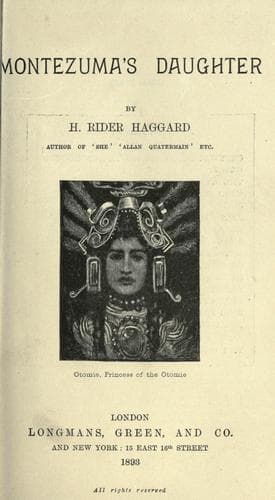
Montezuma's DaughterHaggard, H. Rider (Henry Rider)
History
Montezuma's Daughter
Haggard, H. Rider (Henry Rider)
Mexico -- History -- Conquest, 1519-1540 -- Fiction
“But I have sworn to kill him,” I answered, “and how can I break so
solemn an oath? How could I sit at home in peace beneath the burden of
such shame?”
“I do not know; it is not for me to judge. You must do as you wish, but
in the doing of it, it may happen that you will fall into greater
shames than this. You have fought the man and he has escaped you. Let
him go if you are wise. Now bend down and kiss me, and bid me farewell.
I do not desire that you should see me die, and my death is near. I
cannot tell if we shall meet again when in your turn you have lain as I
lie now, or if we shape our course for different stars. If so, farewell
for ever.”
Then I leant down and kissed him on the forehead, and as I did so I
wept, for not till this hour did I learn how truly I had come to love
him, so truly that it seemed to me as though my father lay there dying.
“Weep not,” he said, “for all our life is but a parting. Once I had a
son like you, and ours was the bitterest of farewells. Now I go to seek
for him again who could not come back to me, so weep not because I die.
Good-bye, Thomas Wingfield. May God prosper and protect you! Now go!”
So I went weeping, and that night, before the dawn, all was over with
Andres de Fonseca. They told me that he was conscious to the end and
died murmuring the name of that son of whom he spoke in his last words
to me.
What was the history of this son, or of Fonseca himself, I never
learned, for like an Indian he hid his trail as step by step he
wandered down the path of life. He never spoke of his past, and in all
the books and documents that he left behind him there is no allusion to
it. Once, some years ago, I read through the cipher volumes of records
that I have spoken of, and of which he gave me the key before he died.
They stand before me on the shelf as I write, and in them are many
histories of shame, sorrow, and evil, of faith deluded and innocence
betrayed, of the cruelty of priests, of avarice triumphant over love,
and of love triumphant over death—enough, indeed, to furnish half a
hundred of true romances. But among these chronicles of a generation
now past and forgotten, there is no mention of Fonseca’s own name and
no hint of his own story. It is lost for ever, and perhaps this is
well. So died my benefactor and best friend.
When he was made ready for burial I went in to see him and he looked
calm and beautiful in his death sleep. Then it was that she who had
arrayed him for the grave handed to me two portraits most delicately
painted on ivory and set in gold, which had been found about his neck.
I have them yet. One is of the head of a lady with a sweet and wistful
countenance, and the other the face of a dead youth also beautiful, but
very sad. Doubtless they were mother and son, but I know no more about
them.
Public-domain text, read in full here on John Shaqi.
Reviews
Reviews
No reviews yet
Be the first to share your thoughts on this work.
Elsewhere in the archive
Join the Discussion
Join the discussion
Sign in to leave a comment or review.
Sign InorCreate an account