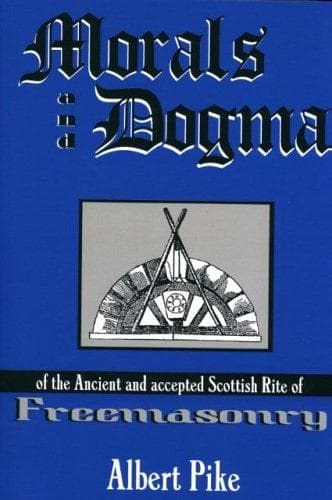
Morals and Dogma of the Ancient and Accepted Scottish Rite of FreemasonryPike, Albert
Religion
Morals and Dogma of the Ancient and Accepted Scottish Rite of Freemasonry
Pike, Albert
Freemasons
The citizen who cannot accomplish well the smaller purposes of public
life, cannot compass the larger. The vast power of endurance,
forbearance, patience, and performance, of a free people, is acquired
only by continual exercise of all the functions, like the healthful
physical human vigor. If the individual citizens have it not, the State
must equally be without it. It is of the essence of a free government,
that the people should not only be concerned in making the laws, but
also in their execution. No man ought to be more ready to obey and
administer the law than he who has helped to make it. The business of
government is carried on for the benefit of all, and every co-partner
should give counsel and co-operation.
Remember also, as another shoal on which States are wrecked, that free
States always tend toward the depositing of the citizens in strata, the
creation of castes, the perpetuation of the _jus divinum_ to office in
families. The more democratic the State, the more sure this result. For,
as free States advance in power, there is a strong tendency toward
centralization, not from deliberate evil intention, but from the course
of events and the indolence of human nature. The executive powers swell
and enlarge to inordinate dimensions; and the Executive is always
aggressive with respect to the nation. Offices of all kinds are
multiplied to reward partisans; the brute force of the sewerage and
lower strata of the mob obtains large representation, first in the lower
offices, and at last in Senates; and Bureaucracy raises its bald head,
bristling with pens, girded with spectacles, and bunched with ribbon.
The art of Government becomes like a Craft, and its guilds tend to
become exclusive, as those of the Middle Ages.
Political science may be much improved as a subject of speculation; but
it should never be divorced from the actual national necessity. The
science of governing men must always be practical, rather than
philosophical. There is not the same amount of positive or universal
truth here as in the abstract sciences; what is true in one country may
be very false in another; what is untrue to-day may become true in
another generation, and the truth of to-day be reversed by the judgment
of to-morrow. To distinguish the casual from the enduring, to separate
the unsuitable from the suitable, and to make progress even possible,
are the proper ends of policy. But without actual knowledge and
experience, and communion of labor, the dreams of the political doctors
may be no better than those of the doctors of divinity. The reign of
such a caste, with its mysteries, its myrmidons, and its corrupting
influence, may be as fatal as that of the despots. Thirty tyrants are
thirty times worse than one.
Public-domain text, read in full here on John Shaqi.
Reviews
Reviews
No reviews yet
Be the first to share your thoughts on this work.
Join the Discussion
Join the discussion
Sign in to leave a comment or review.
Sign InorCreate an account