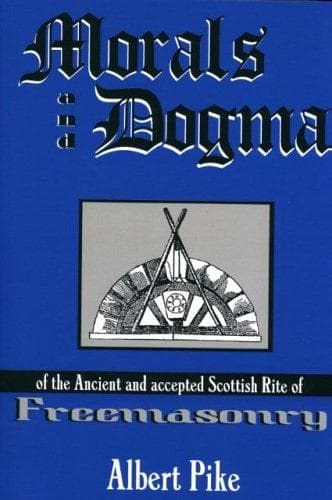
Morals and Dogma of the Ancient and Accepted Scottish Rite of FreemasonryPike, Albert
Religion
Morals and Dogma of the Ancient and Accepted Scottish Rite of Freemasonry
Pike, Albert
Freemasons
In a free country, human speech must needs be free; and the State _must_
listen to the maunderings of folly, and the screechings of its geese,
and the brayings of its asses, as well as to the golden oracles of its
wise and great men. Even the despotic old kings allowed their wise fools
to say what they liked. The true alchemist will extract the lessons of
wisdom from the babblings of folly. He will hear what a man has to say
on any given subject, even if the speaker end only in proving himself
prince of fools. Even a fool will sometimes hit the mark. There is some
truth in all men who are not compelled to suppress their souls and speak
other men's thoughts. The finger even of the idiot may point to the
great highway.
A people, as well as the sages, must learn to forget. If it neither
learns the new nor forgets the old, it is fated, even if it has been
royal for thirty generations. To unlearn is to learn; and also it is
sometimes needful to learn again the forgotten. The antics of fools make
the current follies more palpable, as fashions are shown to be absurd by
caricatures, which so lead to their extirpation. The buffoon and the
zany are useful in their places. The ingenious artificer and craftsman,
like Solomon, searches the earth for his materials, and transforms the
misshapen matter into glorious workmanship. The world is conquered by
the head even more than by the hands. Nor will any assembly talk
forever. After a time, when it has listened long enough, it quietly puts
the silly, the shallow, and the superficial to one side,--it thinks, and
sets to work.
The human thought, especially in popular assemblies, runs in the most
singularly crooked channels, harder to trace and follow than the blind
currents of the ocean. No notion is so absurd that it may not find a
place there. The master-workman must train these notions and vagaries
with his two-handed hammer. They twist out of the way of the
sword-thrusts; and are invulnerable all over, even in the heel, against
logic. The martel or mace, the battle-axe, the great double-edged
two-handed sword must deal with follies; the rapier is no better against
them than a wand, unless it be the rapier of ridicule.
The SWORD is also the symbol of _war_ and of the _soldier_. Wars, like
thunder-storms, are often necessary to purify the stagnant atmosphere.
War is not a demon, without remorse or reward. It restores the
brotherhood in letters of fire. When men are seated in their pleasant
places, sunken in ease and indolence, with Pretence and Incapacity and
Littleness usurping all the high places of State, war is the baptism of
blood and fire, by which alone they can be renovated. It is the
hurricane that brings the elemental equilibrium, the concord of Power
and Wisdom. So long as these continue obstinately divorced, it will
continue to chasten.
Public-domain text, read in full here on John Shaqi.
Reviews
Reviews
No reviews yet
Be the first to share your thoughts on this work.
Join the Discussion
Join the discussion
Sign in to leave a comment or review.
Sign InorCreate an account