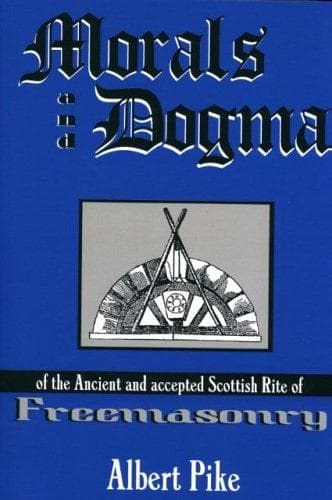
Morals and Dogma of the Ancient and Accepted Scottish Rite of FreemasonryPike, Albert
Religion
Morals and Dogma of the Ancient and Accepted Scottish Rite of Freemasonry
Pike, Albert
Freemasons
The Mysteries were a Sacred Drama, exhibiting some legend significant of
nature's changes, of the visible Universe in which the Divinity is
revealed, and whose import was in many respects as open to the Pagan as
to the Christian. Nature is the great Teacher of man; for it is the
Revelation of God. It neither dogmatizes nor attempts to tyrannize by
compelling to a particular creed or special interpretation. It presents
its symbols to us, and adds nothing by way of explanation. It is the
text without the commentary; and, as we well know, it is chiefly the
commentary and gloss that lead to error and heresy and persecution. The
earliest instructors of mankind not only adopted the lessons of Nature,
but as far as possible adhered to her method of imparting them. In the
Mysteries, beyond the current traditions or sacred and enigmatic
recitals of the Temples, few explanations were given to the spectators,
who were left, as in the school of nature, to make inferences for
themselves. No other method could have suited every degree of
cultivation and capacity. To employ nature's universal symbolism instead
of the technicalities of language, rewards the humblest inquirer, and
discloses its secrets to every one in proportion to his preparatory
training and his power to comprehend them. If their philosophical
meaning was above the comprehension of some, their moral and political
meanings are within the reach of all.
These mystic shows and performances were not the reading of a lecture,
but the opening of a problem. Requiring research, they were calculated
to arouse the dormant intellect. They implied no hostility to
Philosophy, because Philosophy is the great expounder of symbolism;
although its ancient interpretations were often ill-founded and
incorrect. The alteration from symbol to dogma is fatal to beauty of
expression, and leads to intolerance and assumed infallibility.
* * * * *
If, in teaching the great doctrine of the divine nature of the Soul, and
in striving to explain its longings after immortality, and in proving
its superiority over the souls of the animals, which have no aspirations
Heavenward, the ancients struggled in vain to express the _nature_ of
the soul, by comparing it to FIRE and LIGHT, it will be well for us to
consider whether, with all our boasted knowledge, we have any better or
clearer idea of its nature, and whether we have not despairingly taken
refuge in having none at all. And if they erred as to its original place
of abode, and understood literally the mode and path of its descent,
these were but the accessories of the great Truth, and probably, to the
Initiates, mere allegories, designed to make the idea more palpable and
impressive to the mind.
Public-domain text, read in full here on John Shaqi.
Reviews
Reviews
No reviews yet
Be the first to share your thoughts on this work.
Elsewhere in the archive
Join the Discussion
Join the discussion
Sign in to leave a comment or review.
Sign InorCreate an account