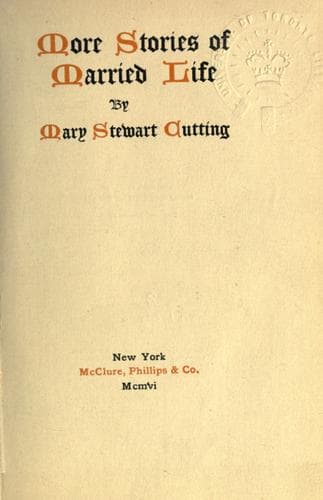
Married people -- United States -- Fiction; United States -- Social life and customs -- 20th century -- Fiction
“Oh, something so horrid happened yesterday! I meant to keep it to
myself, but I can’t.” Betty’s cheeks were red, her eyes were flashing.
“I was at Mrs. Kennedy’s, with those books, and she asked if there was
anything the matter with father, he had been looking so worn lately.
She thought outsiders always noticed those things more quickly than the
family.”
“The idea!” said Mrs. Harlow, indignantly.
“Then when I was in the hall I heard them talking; I couldn’t help it.
They said—she and Mrs. Bradley—what a pity it was when a man didn’t get
on well in business, and Mrs. Tower said she was always so sorry for
the wife of an unsuccessful man; it must be so dreadful, if you had any
ambition, to see your husband a failure. She said she never could really
respect a man who showed himself deficient. I was so angry I could hardly
walk home. I went up-stairs and cried. I wanted to burst right in and
tell them how nobly father had behaved when that old Johnson absconded,
and how he was trying to pay up all the back debts. But I knew it wasn’t
any use——”
“Deficient!” Mrs. Harlow’s eyes glittered. “Your father’s brain—well,
your father’s brain is far beyond most people’s. How he can make all
those calculations the way he does——” She paused. Her own education dated
back of the modern era. She was sound on the arithmetic of her butcher’s
and grocer’s books, but beyond that all figures looked to her much like a
drop of water seen through a microscope.
“There’s the whistle!” said Betty, suddenly jumping up and making for the
train to meet her best friend.
The subject of this conversation had meanwhile been wending his way to
the town. He perhaps had looked forward to a time of pecuniary ease and
leisure, when, instead of tinkering round the house, he might play golf.
But no one, not even his wife, quite understood what a holiday meant to
Mr. Harlow.
To escape for a solid block of sunlit secular hours out of the grimy,
artificially lighted, badly ventilated office, with its white,
tired-looking clerks, and its association of intricate, harassing toil—to
escape from this to the peacefulness of green grass, and the click of the
lawn-mower, and the flickering of shade from the new leaves of the elms
that arched the street, and the sweet voices of little children calling
to one another, was to go back into a little corner of the emerald fields
of boyhood.
Mr. Harlow was not in the least old; he was indeed barely middle-aged;
yet there were moments when he knew that he was not so young as he had
been. On the spring morning of a holiday the thought, even if it came,
was robbed of its shadow.
His face had the kind smile that children always trusted, as he stopped
to pick up a tiny, curly-haired girl who had fallen in his way. The
action showed him the letter, which he had forgotten, still in his hand.
Public-domain text, read in full here on John Shaqi.
Reviews
Reviews
No reviews yet
Be the first to share your thoughts on this work.
Elsewhere in the archive
Join the Discussion
Join the discussion
Sign in to leave a comment or review.
Sign InorCreate an account