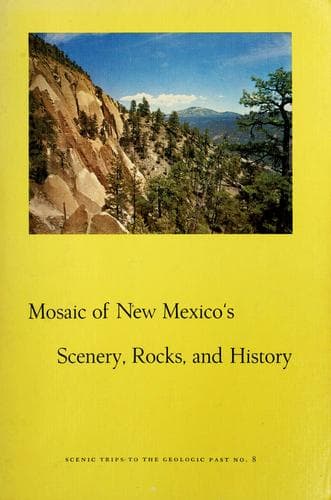
Mosaic of New Mexico's Scenery, Rocks, and History — John Shaqi
Mosaic of New Mexico's Scenery, Rocks, and History
History
Mosaic of New Mexico's Scenery, Rocks, and History
Geology -- New Mexico; New Mexico -- Description and travel; New Mexico -- History
During the Ordovician Period, 425 to 500 m.y. ago, upper sands of the
Bliss as well as overlying limestones and dolomites were deposited in
the shallow warm seas of southern New Mexico; these latter rocks are the
El Paso Limestone and Montoya Dolomite. The Ordovician seas teemed with
invertebrate life. Fifteen-foot-long cephalopods, as much as a foot in
diameter, ruled the shallow salt-water bottoms, munching on the abundant
trilobites and the moss animals, the bryozoans. Numerous brachiopods,
corals, snails, and clams also thrived, with many of the Ordovician
carbonate-rock beds literally being made up of these fossil remains.
Near El Paso, these limy fossiliferous beds are nearly 2000 feet thick,
but they thin northward to a knife edge in thickness near Mockingbird
Gap at the north end of the San Andres Mountains. Parts of northwestern
New Mexico may have been low islands exposed to the sun and erosion
during Ordovician time, but most of the state was probably within an
extensive shallow ocean. Later, erosion removed the Ordovician rocks
from central and northern New Mexico.
Silurian strata, the brown Fusselman Dolomite, deposited during the
middle of that period (400 to 425 m.y. ago), remain only in the southern
and southeastern parts of the state, thinning out northward from the
1000-foot-thick bed near El Paso. The extent of these middle Silurian
seas is not known, but most of central and northern New Mexico was
undergoing erosion during late Silurian time. The northward thinning of
the Fusselman Dolomite is due chiefly to this erosion, evidenced by the
knobby, ridged and channeled top surface of the Fusselman. Brachiopods
and corals are the most abundant fossils in the Fusselman Dolomite;
elsewhere, Silurian rocks are known for the sea scorpions or
eurypterids, which attained a length of nine feet, and for the complete
remains of primitive fishes.
During early and middle Devonian time (345 to 400 m.y. ago), most of New
Mexico was a lowland rotting beneath the sun. Fossiliferous Devonian
rocks are unknown in the north-central part of the state but occur
beneath the surface in the Four Corners region of northwestern New
Mexico and the adjoining states. These rocks are of late Devonian age
and consist of lower dolomite and sandstone, middle shale and dolomite,
and the upper Ouray Limestone.
In southern New Mexico, a uniform blanket of dark limy muds, called the
Percha Shale, was deposited during late Devonian time. This shale marks
a great change from the limestones of earlier ages. In part, it is of
black muds deposited in widespread or in local stagnant basins and in
part calcareous fossiliferous muds in which abundant invertebrate life
was buried. The clay and quartz silt that make up the rocks were a
weathered residuum that had accumulated, during the long period of late
Silurian and early and middle Devonian times, on the lowland of central
and northern New Mexico.
Public-domain text, read in full here on John Shaqi.
Reviews
Reviews
No reviews yet
Be the first to share your thoughts on this work.
Join the Discussion
Join the discussion
Sign in to leave a comment or review.
Sign InorCreate an account