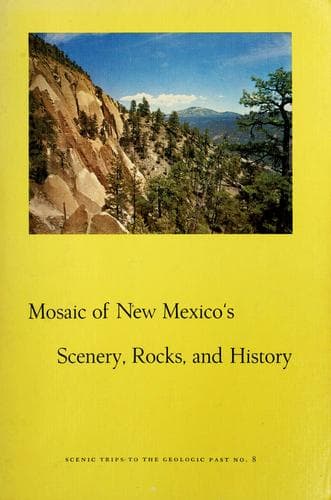
Mosaic of New Mexico's Scenery, Rocks, and History
History
Mosaic of New Mexico's Scenery, Rocks, and History
Geology -- New Mexico; New Mexico -- Description and travel; New Mexico -- History
These Precambrian rocks now make up the cores of such mountain ranges as
the Sandias east of Albuquerque, the Sangre de Cristo range near Santa
Fe, the Pedernal Hills south of Clines Corners, the Burro Mountains
southwest of Silver City, the Brazos Range east of Tierra Amarilla, the
Zuni Mountains southwest of Grants, and the San Andres Mountains west of
White Sands. As seen in Tijeras Canyon east of Albuquerque, the bulk of
the ancient rocks are gray to pinkish granite and granite gneiss,
speckled by crystals of biotite, microcline, orthoclase, and quartz.
Quartzites (hardened sandstones), greenstone, and foliated mica schists
(fig. 5) are the older rocks that were intruded by granitic magmas about
1350 million years ago—as indicated by dating of radioactive isotopes,
K-Ar and Rb-Sr. Locally, pegmatite dikes, a late-cooling, large-crystal
stage of the granites, crisscross the granite and contain excellent
crystals of quartz, feldspar, and mica, as well as less common minerals.
The famous Harding pegmatite near Dixon, about forty miles north of
Santa Fe, contains beryl, columbite-tantalite, lepidolite mica,
spodumene, and other rare minerals. Some of these crystals are ten feet
in length!
PALEOZOIC ERA
There are some primitive types of plant and animal life known from
Precambrian rocks outside of New Mexico but the earliest beds that
contain abundant fossils are those of Cambrian age, 500 to 600 m.y. old.
Cambrian rocks in New Mexico are in the Bliss Sandstone, a reddish brown
iron-rich bed, 50 to 200 feet thick, that occurs only in the southern
part of the state. There it can be seen, for example, along the bold
east-facing escarpment of the San Andres Mountains or the west-facing
cliffs of the Caballo Mountains, as a dark band resting on the pinkish
Precambrian granitic rocks. It is a shallow-sea sand, deposited on the
northeastern edge of the Cambrian seas. Scattered amid the brown-stained
quartz, red hematite, and green glauconite are broken shells of
trilobites and primitive brachiopods. Northern New Mexico was a low,
broad island during Cambrian time, a source of some of the sands in the
Bliss Sandstone.
Public-domain text, read in full here on John Shaqi.
Reviews
Reviews
No reviews yet
Be the first to share your thoughts on this work.
Join the Discussion
Join the discussion
Sign in to leave a comment or review.
Sign InorCreate an account