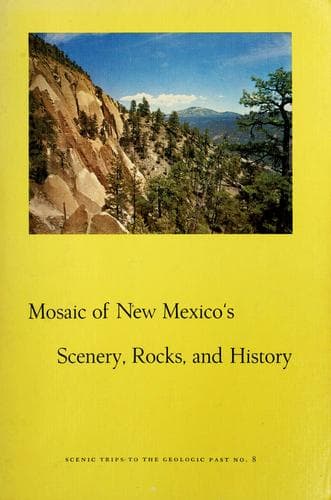
Mosaic of New Mexico's Scenery, Rocks, and History
History
Mosaic of New Mexico's Scenery, Rocks, and History
Geology -- New Mexico; New Mexico -- Description and travel; New Mexico -- History
The Chinle Formation is of special scenic interest as its beds contain
the silicified trees so well shown at Petrified Forest National
Monument. These varicolored rocks—red, purple, green, and gray—also
decorate the Painted Desert area, the wide valley of Rio San Jose east
of Laguna, and flank Interstate 40 (U.S. Highway 66) from the Texas line
westward almost to Clines Corners. As some beds are weathered “ash”
beds, the highlands were sites of volcanoes that spread their dust over
much of the Southwest. In contrast to the underlying marine Paleozoic
rocks, these Triassic beds were deposited on land by streams and in
shallow lakes. Thus the beasts that roamed New Mexico were
amphibians—such as the thick-skulled stegocephalians—and reptiles of the
crocodilelike clan, the phytosaurs. The silicified trees in the Chinle
are mostly primitive pines; some grew to heights of more than 100 feet
and measure 7 feet in diameter.
New Mexico was featureless rolling prairie, with scattered low hills in
the northwest, during most of Jurassic time (135 to 180 m.y. ago). In
the late part of the period, the Sundance-Curtis sea and its shoreline
lagoons spread down from the north into northwestern New Mexico. Sand
dunes on its southeastern shores consolidated into the cross-bedded
Entrada Sandstone; its reddish brown cliffs rim the Rio San Jose Valley
near Grants and Gallup. In an extensive lagoon, or salt-water lake that
covered most of northwestern and north-central New Mexico, the gypsum
and limestone of the Todilto Formation were precipitated; this gypsum is
the bed mined near Rosario siding (seen between Albuquerque and Santa
Fe) by the Kaiser Gypsum Company, and near San Ysidro on White Mesa by
the American Gypsum Company. The Todilto salty basin was overwhelmed by
reddish sands and silts of the Summerville Formation, washed chiefly
from the south, and by the multicolored sands of the Zuni Sandstone
(exposed at El Morro), and then the stream and wind-blown sands and
clays of the varicolored Morrison Formation were laid down in northern
New Mexico. Petrified wood and bone fragments are abundant in the
Morrison beds—along with uranium—but no fossil finds in New Mexico equal
those in the Morrison Formation of Dinosaur National Park, Utah.
Much of North America, including southern New Mexico, was land during
the Jurassic. In the streams and lakes were many kinds of fishes,
amphibians, reptiles, snails, crustaceans, and water bugs; on dry land
were hordes of reptiles, small primitive mammals, and ants; in the air
were flying reptiles, the earliest known birds, moths, and butterflies.
The earth was ruled by the reptiles, with the dinosaurs dominant—some
being the most ponderous land animals of all earth history. Such were
Stegosaurus and Brachiosaurus, the latter 85 feet long and weighing 50
tons.
Public-domain text, read in full here on John Shaqi.
Reviews
Reviews
No reviews yet
Be the first to share your thoughts on this work.
Elsewhere in the archive
Join the Discussion
Join the discussion
Sign in to leave a comment or review.
Sign InorCreate an account