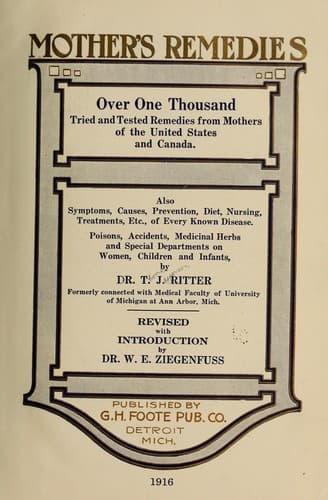
Mother's Remedies: Over One Thousand Tried and Tested Remedies from Mothers of the United States and CanadaRitter, Thomas Jefferson
Science
Mother's Remedies: Over One Thousand Tried and Tested Remedies from Mothers of the United States and Canada
Ritter, Thomas Jefferson
Etiquette; Formulas, recipes, etc.; Medicine, Popular
PHYSICIANS' TREATMENT.--The first few weeks, cleansing the nose with
peroxide of hydrogen will stop the odor. First, remove the scabs with
forceps and then wash and cleanse the nose with the peroxide solution. It
can be used from one-quarter strength to full strength, but warm. This
will leave the nose in a foamy, soapy condition and this can be cleansed
with a mild solution of glyco-thymoline or salt water.
HOME TREATMENT.--This is very important. The patient should use a douche
three or four times a day. In the solution glyco-thymoline or borolyptol
one or two teaspoonfuls to one-half cup of warm water, and follow by a
nebulizer or atomizer in which the following solution can be used:
1. Lysol 10 drops
Oil of Pine 15 drops
Liquid Alboline 2 ounces
Mix and make a solution, spray into the nose after douching.
[RESPIRATORY DISEASES 17]
2. The following ointment can be used if there is no atomizer or nebulizer
at hand:
Iodol 5 grains
Boric Acid 10 grains
Cold cream 2 ounces
Mix and make into an ointment, and rub a little into each nostril before
retiring.
3. Dr. Ferguson of New York uses the following: A new antiseptic enzymol.
This is used as follows.--Use one part of enzymol, three parts of warm
water. Rub and cleanse the nose thoroughly with the solution, saturate a
piece of absorbent cotton with this solution, place it in the nostril and
leave it there fifteen to twenty minutes.
HAY FEVER. (Rose Cold, June Cold or Hay Asthma).--This inflammation of the
nose occurs in August and September. It is really a nervous affection of
the nose membrane.
Causes.--A predisposition: A peculiar sensitive area in the mucous
membrane of the nose. An exciting cause circulating in the air, the dust
or pollen of certain plants, such as rag-weed, hay and barley; the odor of
certain flowers, such as roses and golden rod; dust of some drugs as
ipecac and benzoic acid; the odor of some animals. It usually comes about
the same date each year, growing worse each year and, in time, affects the
bronchial tubes.
Public-domain text, read in full here on John Shaqi.
Reviews
Reviews
No reviews yet
Be the first to share your thoughts on this work.
Join the Discussion
Join the discussion
Sign in to leave a comment or review.
Sign InorCreate an account