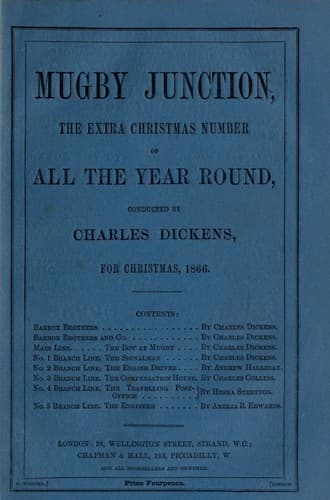
Psychological fiction; Railroad stations -- England -- London -- Fiction
“Ah!” she said, “nothing was easier. Monsieur Bonnard had described the
van to me, and you remember I put the box down at the end of the counter,
close to the corner where I hid myself at every station. There was a
door with a window in it, and I asked if I might have the window open, as
the van was too warm for me. I believe Monsieur Bonnard could have taken
it from me by only leaning through his window, but he preferred stepping
out, and taking it from my hand, just as the train was leaving Watford—on
the far side of the carriages, you understand. It was the last station,
and the train came to a stand at Camden-town. After all, the box was not
out of your sight more than twenty minutes before you missed it.
Monsieur Bonnard and I hurried out of the station, and Alfred followed
us. The box was forced open—the lock has never been mended, for it was a
peculiar one—and Monsieur Bonnard took possession of the papers. He left
the box with me, after putting inside it a roll of notes. Alfred and I
were married next morning, and I went back to my aunt’s; but we did not
tell papa of our marriage for three or four months. That is the story of
my red morocco workbox.”
She smiled with the provoking mirthfulness of a mischievous child. There
was one point still, on which my curiosity was unsatisfied.
“Did you know what the despatches were about?” I asked.
“O no!” she answered; “I never understood politics in the least. I knew
nothing about them. Monsieur did not say a word; he did not even look at
the papers while we were by. I would never, never, have taken a
registered letter, or anything with money in it, you know. But all those
papers could be written again quite easily. You must not think me a
thief, Mr. Wilcox; there was nothing worth money among the papers.”
“They were worth five hundred pounds to you,” I said. “Did you ever see
Bonnard again?”
“Never again,” she replied. “He said he was going to return to his
native country. I don’t think Bonnard was his real name.”
Most likely not, I thought; but I said no more to Mrs. Forbes. Once
again I was involved in a great perplexity about this affair. It was
clearly my duty to report the discovery at head-quarters, but I shrank
from doing so. One of the chief culprits was already gone to another
judgment than that of man; several years had obliterated all traces of
Monsieur Bonnard; and the only victim of justice would be this poor
little dupe of the two greater criminals. At last I came to the
conclusion to send the whole of the particulars to Mr. Huntingdon
himself; and I wrote them to him, without remark or comment.
Public-domain text, read in full here on John Shaqi.
Reviews
Reviews
No reviews yet
Be the first to share your thoughts on this work.
Join the Discussion
Join the discussion
Sign in to leave a comment or review.
Sign InorCreate an account