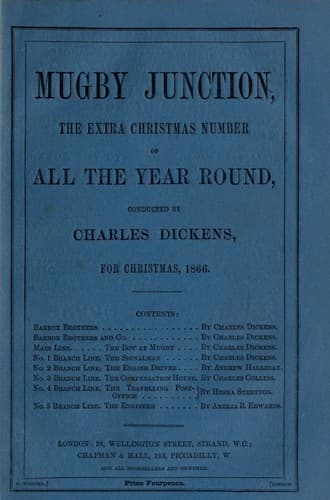
Psychological fiction; Railroad stations -- England -- London -- Fiction
She laughed aloud—such a merry, mocking, musical laugh, like a chime of
silver bells!
“You ask too much,” she said.
“Only what you have led me to hope these five or six months past!”
“That is just what Matteo says. How tiresome you both are!”
“O, Gianetta,” I said, passionately, “be serious for one moment! I am a
rough fellow, it is true—not half good enough or clever enough for you;
but I love you with my whole heart, and an Emperor could do no more.”
“I am glad of it,” she replied; “I do not want you to love me less.”
“Then you cannot wish to make me wretched! Will you promise me?”
“I promise nothing,” said she, with another burst of laughter; “except
that I will not marry Matteo!”
Except that she would not marry Matteo! Only that. Not a word of hope
for myself. Nothing but my friend’s condemnation. I might get comfort,
and selfish triumph, and some sort of base assurance out of that, if I
could. And so, to my shame, I did. I grasped at the vain encouragement,
and, fool that I was! let her put me off again unanswered. From that
day, I gave up all effort at self-control, and let myself drift blindly
on—to destruction.
At length things became so bad between Mat and myself that it seemed as
if an open rupture must be at hand. We avoided each other, scarcely
exchanged a dozen sentences in a day, and fell away from all our old
familiar habits. At this time—I shudder to remember it!—there were
moments when I felt that I hated him.
Thus, with the trouble deepening and widening between us day by day,
another month or five weeks went by; and February came; and, with
February, the Carnival. They said in Genoa that it was a particularly
dull carnival; and so it must have been; for, save a flag or two hung out
in some of the principal streets, and a sort of festa look about the
women, there were no special indications of the season. It was, I think,
the second day when, having been on the line all the morning, I returned
to Genoa at dusk, and, to my surprise, found Mat Price on the platform.
He came up to me, and laid his hand on my arm.
“You are in late,” he said. “I have been waiting for you three-quarters
of an hour. Shall we dine together to-day?”
Impulsive as I am, this evidence of returning good will at once called up
my better feelings.
“With all my heart, Mat,” I replied; “shall we go to Gozzoli’s?”
“No, no,” he said, hurriedly. “Some quieter place—some place where we
can talk. I have something to say to you.”
I noticed now that he looked pale and agitated, and an uneasy sense of
apprehension stole upon me. We decided on the “Pescatore,” a little
out-of-the-way trattoria, down near the Molo Vecchio. There, in a dingy
salon, frequented chiefly by seamen, and redolent of tobacco, we ordered
our simple dinner. Mat scarcely swallowed a morsel; but, calling
presently for a bottle of Sicilian wine, drank eagerly.
“Well, Mat,” I said, as the last dish was placed on the table, “what news
have you?”
“Bad.”
Public-domain text, read in full here on John Shaqi.
Reviews
Reviews
No reviews yet
Be the first to share your thoughts on this work.
Elsewhere in the archive
Join the Discussion
Join the discussion
Sign in to leave a comment or review.
Sign InorCreate an account