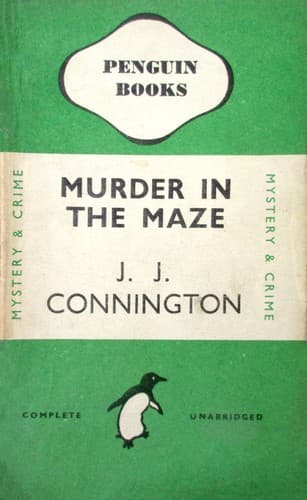
Country homes -- England -- Fiction; Detective and mystery stories; Murder -- Investigation -- Fiction
“I’ve a good mind to take you at your word, and you’ll have only
yourself to thank if it bores you. To begin with, then, there are
three basic points on which a prosecutor has to satisfy the judge—or
the jury, if it’s a jury case. These are: opportunity, method, and
motive. It isn’t absolutely necessary to prove motive; but one does
what one can to establish it if possible. A jury might be chary of
convicting unless they saw something of the sort.”
“You might expand that a bit,” Wendover suggested. “All you’ve given
me is three words.”
“Take them one by one,” Sir Clinton went on. “First of all,
opportunity. The accused man must be somebody who had a real chance of
committing the crime—somebody who isn’t excluded by ordinary physical
impossibilities. If a body with its throat freshly cut were to fall
into this room at the present moment, it would be no use trying to
bring a case against the Mikado or the President of the United States.
We know that they’re thousands of miles away at this time. It would be
physically impossible for them to have done the trick.”
“That’s self-evident,” said Wendover. “A murderer’s bound to have been
on the spot when he committed his murder.”
“Not necessarily,” Sir Clinton contradicted at once. “A poisoner
needn’t be near his victim when the victim dies. He might have sent
poisoned chocolates by post or something like that. But he must have
had the opportunity of committing the crime, whether he was on the
spot or not. You couldn’t have accused Robinson Crusoe in a poisoned
chocolates case; he was outside the postal radius.”
Wendover nodded in agreement.
“But in this particular case at the Maze,” he commented, “it’s pretty
plain that the murderer was on the spot all right. The person who
killed the Shandons was somebody who was in or near the Maze between
three and four o’clock this afternoon.”
Sir Clinton passed to his second point.
“Method is the next thing. It’s an axiom that the more ordinary the
method of killing is, the more difficult it is to spot the murderer.
Suppose you find a body in a by-street and it turns out that the man
has been stabbed to death. What have you to go on? Not much. But if
you find somebody poisoned with some fairly out-of-the-way alkaloid,
then you limit the number of possible murderers very considerably. You
remember the Crippen case. Divergence from the normal is the weakest
link in a murderer’s chainmail.”
“Well, you ought to be happy in this affair. You’ve got a sufficiently
out-of-the-way method.”
“That’s so,” Sir Clinton admitted. “But what you gain on the swings
you sometimes lose on the roundabouts, you know. The method in this
case was one that either a man or a woman could have used. Even a
child can pull a trigger. That extends the range a bit.”
“But a child would need to have had the chance of getting at the
curare.”
“And the curare has been lying open to anyone for the last year or
two. Don’t forget that.”
Public-domain text, read in full here on John Shaqi.
Reviews
Reviews
No reviews yet
Be the first to share your thoughts on this work.
Elsewhere in the archive
Join the Discussion
Join the discussion
Sign in to leave a comment or review.
Sign InorCreate an account