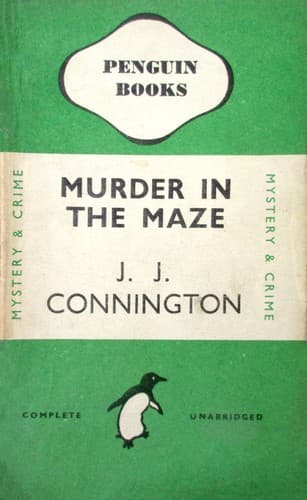
Country homes -- England -- Fiction; Detective and mystery stories; Murder -- Investigation -- Fiction
“What’s wrong with your outlook on the business, Squire, is that you
want to treat a real crime as if it were a bit clipped out of a
detective novel. In a ’tec yarn, you get everything nicely sifted for
you. The author puts down only things that are relevant to the story.
If he didn’t select his materials, his book would be far too long and
no one would have the patience to plough through it. The result is
that the important clues are thrown up as if they had a spotlight on
them, if the reader happens to have any intelligence.”
He paused to light a cigarette before he continued.
“In real life,” he went on, “there isn’t any of this kind of
simplification. You get a mass of stuff thrown at your head in the way
of evidence; and in the end nine-tenths of it usually turns out to be
completely irrelevant. You’ve got to sift the grain from the chaff
yourself, with no author to do the rough work for you. Do you remember
the Map-game?”
Wendover shook his head.
“I don’t recognise it from the title.”
“You must have played it sometime or other when you were a kid,” Sir
Clinton continued. “One player chooses a name on a map; the other
player’s got to find out which name it is. He can ask any questions he
likes, provided that the first player can answer them by a plain ‘Yes’
or a ‘No.’ Now that game is something like detective work, though the
problem’s much easier to solve. Curiously enough, the really clever
player doesn’t choose a name in tiny type—only the beginner does that.
The expert picks out some name like France, or Germany, or
Czecho-Slovakia—something that stretches half-way across the map. Then
when the opponent asks: ‘Is it on this half of the map?’ the expert
answers ‘No,’ quite truthfully; and the beginner at once assumes that
it must be in the other half and proceeds accordingly, quite
forgetting that it may be on both halves simultaneously. That’s the
kind of thing that may turn up in criminal-hunting. The fellow you’re
after may be—in fact he generally is—playing two parts simultaneously.
He’s not only a criminal; he’s a normal member of society as well—at
least in murder cases he usually is. He stretches over both halves of
the map, you see? And if you insist on looking at one half only, you
miss him completely.”
“That’s a long suit of talk you had in your hand,” Wendover commented.
“You seem very flush of information on some points.”
Sir Clinton laughed, admitting the hit.
“You asked for a lecture, and now it seems you don’t care for it when
you get it. Well, try your hand yourself. Let’s hear what you’ve made
of the case. I’m not afraid of prejudice now.”
Wendover glanced at his friend with some suspicion; but he seemed
reassured by what he saw. Sir Clinton appeared to be quite anxious to
hear his ideas.
Public-domain text, read in full here on John Shaqi.
Reviews
Reviews
No reviews yet
Be the first to share your thoughts on this work.
Elsewhere in the archive
Join the Discussion
Join the discussion
Sign in to leave a comment or review.
Sign InorCreate an account