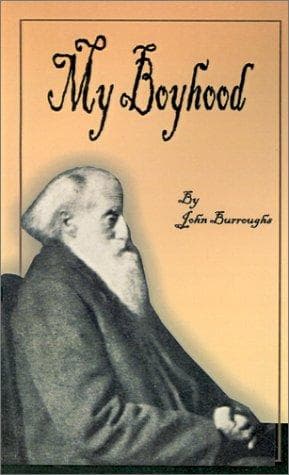
Burroughs, John, 1837-1921 -- Childhood and youth; Naturalists -- New York (State) -- Biography
"You're fast now, boy, it's just as Dick said," he exclaimed as I rowed
as hard as I could for the long line of buoys. Never can I forget the
hour of alarm and distress, for me, that followed. The tide turned and
the loitering flood gave way to the sweeping ebb, the dark water from
the creek came rushing down on us, the buoys swirled and twisted in the
running water and began to disappear one by one. We quickly got hold
of the end and I picked up as much as I could; then Father got hold and
tried to pull the net loose. He pulled and pulled until he literally
pulled the stern of the skiff under water.
"You'll have to cut the net, it is the only way," he said finally,
red-faced and panting, so we did cut the net, leaving a middle section
there on the old stake in the bottom of the river. There is no denying
that it was thoughtful of him to come, and that he had my safety and
welfare at heart. Though I was always cautious and wise to the way of
the river, something might have happened and my bones might be there
beside the old stake--and what a lot I would have missed!--or as Father
once so aptly expressed it: "I'm not afraid to die, but I enjoy so much
living!"
He was always cautioning me, and worrying about me when I was out on
the river, especially at night, and yet he took chances that I would not
take. In the early days here at Riverby there was no railroad on this
side of the Hudson, and to get a train one must cross the river. In
summer one hung out a white flag from West Park dock and Bilyou would
row over for you, but when there was ice in the river one must walk or
stay home. In zero weather it was only a matter of a long walk over the
ice, often facing a blast of below-zero wind, but when the March thaws
had begun one took one's life very lightly to venture on the ice. The
thawing water cut away the ice from underneath, leaving no mark on the
surface, weakening it in spots, and if one went through, the tide swept
him under the ice, where the water was at least cold enough to chill one
and make death easy. On such a day Father crossed the river on a crack,
for, strange to say, one of the big cracks that always come in the ice
had pushed or folded down, and not up, and the water had frozen over,
making a streak of triple-thick ice, and on this streak he crossed the
Hudson, the ice so far gone from the sun, so honeycombed and rotten,
that he could stick his cane through on either side of his crack!
Another time he was crossing in early April with his dog, and when in
the middle of the river, which is a full half mile wide at Riverby, busy
with his thoughts, he suddenly saw his dog running for the shore, which
apparently was moving away rapidly toward New York! But the shores were
standing eternally still; the ice it was that moved, and was moving up
with the flood tide, moving just the width of a big canal that the ice
harvesters had cut above. When the tide turned, about an hour later, all
the ice went out of the river.
Public-domain text, read in full here on John Shaqi.
Reviews
Reviews
No reviews yet
Be the first to share your thoughts on this work.
Join the Discussion
Join the discussion
Sign in to leave a comment or review.
Sign InorCreate an account