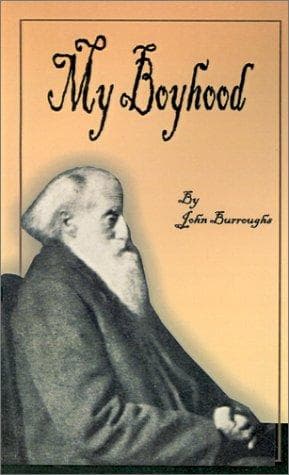
Burroughs, John, 1837-1921 -- Childhood and youth; Naturalists -- New York (State) -- Biography
When first Father saw some smokeless powder he was surprised at its
appearance, and would not believe it was powder, until he threw some on
the hot stove. I used it in our old shotgun and he was much alarmed,
yet he told me that in his hunt for Thomas's Lake, of which he speaks
in "Wake Robin," he loaded his little muzzle-loading gun with an entire
handful of powder and then, for he felt it would burst, he held it at
arm's length over his head to fire. This he did time after time, in his
attempt to signal to his companions. The little gun survived the ordeal
and hangs now in the gun room. With it is the little cane gun, a small
shotgun that looked exactly like a cane, but which was quite effective
for small birds, and which he used when making collections of birds
about Washington. Strangely enough for those days, it was against the
law to shoot birds, and mounted guards enforced this law. Father would
tell with glee how he would shoot a bird he wanted for his collection,
and in a moment the guard would come rushing up, asking who fired the
shot, and Father would tell him it was just over the rise of ground, or
behind those trees, or something, and off would hurry the guard while
Father picked up his bird and reloaded his cane. It seems queer to us
now--to think of John Burroughs as shooting and mounting song birds,
making collections to be set up on a tree behind glass, but he did, for
in those days they were quite the proper thing, cases of them, fitting
enough for museums, often being seen in private homes. I can remember
taking lessons in taxidermy from Father, and of skinning and mounting
wildfowl, and today there are a loon and a prairie chicken here in the
house at Riverby that he mounted in those early years. The collections
of birds he made are scattered far and wide or were destroyed long ago.
All of them were shot with the little muzzle-loading cane gun or with a
little muzzle-loading fowling piece: those were the days of the ramrod
and wasps' or hornets' nests gathered and used for wadding, and the
superstition, which Father often expressed, that if you spilled or
dropped a shot in loading, it was your game shot, the one that would
have killed and without which the shot would miss. I can see the
fascinating-looking black powder now, scintillating as Father poured it
from the palm of his short brown hand into the muzzle of the gun.
Public-domain text, read in full here on John Shaqi.
Reviews
Reviews
No reviews yet
Be the first to share your thoughts on this work.
Join the Discussion
Join the discussion
Sign in to leave a comment or review.
Sign InorCreate an account