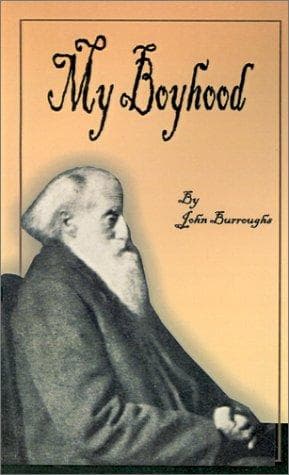
Burroughs, John, 1837-1921 -- Childhood and youth; Naturalists -- New York (State) -- Biography
The southwest bedroom on the third floor Father was to have for his
room, his study, where he could write. This room he panelled to the
ceiling with native woods: maple, oak, beech, birch, tulip, and others,
and I like to think of his happy anticipation, his dreams of the happy
hours he would spend in this room, and of the writing he would do. But
he did no writing here, for a few years later he built the bark-covered
study down on the edge of the bank, then a few years later yet he built
Slabsides, two miles over the low mountain. It was there, especially in
the study, that he did the bulk of all his literary work.
Mother was a materialist; she never rated literary efforts very high;
she often seemed to think that Father should do the work of the hired
man and then do his writing nights and holidays. She could see no sense
in taking the best hours of the day for "scribbling," and it was only in
the later years when Father had a steady income from his writings that
her point of view softened. She was what they called in those days a
"good housekeeper" and she kept it so well that Father had to move out
for his working hours, first to the study, then two miles away. When it
came to housework, Mother possessed the quality called inevitableness
to an extraordinary degree. She had a way of fastening a cloth about
her head, a sort of forerunner of the boudoir cap of to-day, a means of
protecting her hair from any imaginary dust, and this became a symbol,
a battle flag of the goddess of housecleaning. Father was ordered out of
the library, where he did his writing, and his thread was rudely broken;
it was a day when sap did not run. For a high-strung, temperamental
being, hasty and quick tempered, I think he showed wonderful patience, a
patience that does him great credit. And yet in many ways Mother was
an invaluable helpmate, she was a balance wheel that kept their world
moving steadily, and I am sure saved Father from many mistakes and
extravagances.
It was only years afterward, when he began to ship grapes, that Father
named his place "Riverby." He had been reading a book of adventure
to me, Stevenson's "Black Arrow," and in it there was a place named
"Shoreby," or "by-the-shore." This suggested the name of "Riverby," or
"by-the-river," to Father for his place. So it was adopted and became
the trademark, "Riverby Vineyards," an oval stamp with a bunch of grapes
in the middle and the address below. It became the name of the place,
the name of one of Father's books, and was stamped on the lid of every
crate or basket of grapes.
Public-domain text, read in full here on John Shaqi.
Reviews
Reviews
No reviews yet
Be the first to share your thoughts on this work.
Elsewhere in the archive
Join the Discussion
Join the discussion
Sign in to leave a comment or review.
Sign InorCreate an account