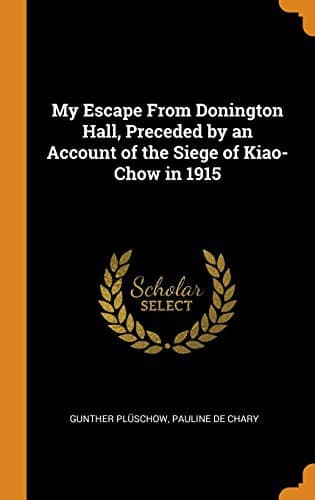
My Escape from Donington Hall, Preceded by an Account of the Siege of Kiao-Chow in 1915Plüschow, Gunther
History
My Escape from Donington Hall, Preceded by an Account of the Siege of Kiao-Chow in 1915
Plüschow, Gunther
Prisoner-of-war escapes; World War, 1914-1918 -- Personal narratives, German; World War, 1914-1918 -- Prisoners and prisons, British
Alcohol was forbidden; but even in England rules seemed made only to
be broken. One of our warders belonged to a masonic lodge, members of
which were widely distributed over England and America. My colleague,
the locksmith, happened to be Master. When the soldier saw the
Freemasons’ sign in my friend’s buttonhole, their pact was sealed. A
small canteen flourished in the basement of our prison, and one after
another we were led down by the kindly brother, and returned thence
fortified, with pockets bulging with beer bottles.
The joke was that our sentries, who stood on guard before our door,
allowed us to go away quietly, and even begged us to bring them up
a few bottles of beer. At 9 p.m. our sentries had become so chummy
that we practised rifle exercises together, and at 11 p.m. one sentry
dropped his rifle altogether and tumbled backwards, with the coal-box,
on which he had been sitting, atop of him.
If I had possessed the experience which was mine after five months’
captivity, I should have escaped even then.
In this prison, as well as in all other camps where we foregathered
with the English Tommies, their first request, after we had become
better acquainted, was for a little note with our address and possibly
the address of friends in Germany, and an attestation that the English
soldier So-and-so had treated us well. These notes were treasured by
them as relics, to be produced at the Front, or in case of capture by
the Germans.
We were given tiny camp palliasses, which were so short that our legs
projected from the calves downwards, and so narrow that it would have
taken an ingenious circus performer to balance his back on it. We also
had two blankets each. We slept like logs, though, it is true, the next
morning found us all on the floor alongside the mattresses.
On the following morning—it was Sunday—we received the visit of an
Army officer of high rank. He inquired after our wishes. I pointed out
repeatedly that I was an officer, and had the right to be treated as a
prisoner of war. He was most charming, and promised me many things when
we should arrive at our destination—but kept none of them.
At last, on the Monday, we were allowed to leave our prison. As usual,
closely guarded by our escort, we were marched to the harbour, where
we boarded a small steamer, and after an hour’s journey reached a huge
ship which was used as a prisoners’ camp. After a long palaver we were
obliged to put out to sea again, for the Commandant declared that he
had no information about us, and no room either. Though this comedy
was re-enacted on the next steamer, the Cunard liner _Andania_, the
fluency of our Major’s vituperations probably surpassed that of the
Camp Commandant’s; anyway, we went on board after half an hour’s delay.
A fat, bumptious, English Lieutenant, who filled the post of Camp
Commandant and interpreter on this boat, received us.
Public-domain text, read in full here on John Shaqi.
Reviews
Reviews
No reviews yet
Be the first to share your thoughts on this work.
Elsewhere in the archive
Join the Discussion
Join the discussion
Sign in to leave a comment or review.
Sign InorCreate an account