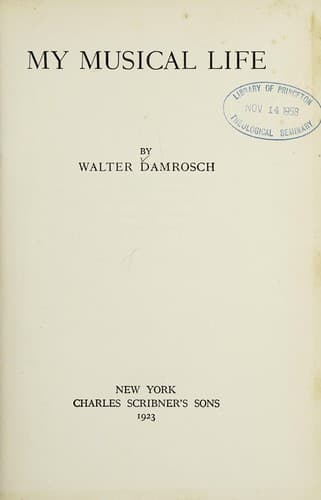
Conductors (Music) -- United States -- Biography; Damrosch, Walter, 1862-1950
As a boy he had had hardly any school education, but he had inherited
the Scotch passion for books. He had read omnivorously and, what is
better still, remembered what he read. Burns and Shakespeare he knew by
heart and could quote very aptly to clinch a point in his arguments.
His sympathy for suffering, especially that caused by poverty, was very
great and expended itself in practical help in every direction. The hard
struggles of his early youth had made him very understanding, and many
widows left destitute received immediate help from him and the children
were put through school and placed in business through his assistance.
His attitude toward religion was very curious. In those days he
professed to be an agnostic, but he had old Scotch prejudices in favor
of a “Scotch Sunday.” He despised theology and yet was really religious,
but he did not care to define his God or to explore the mysteries or
possibilities of a future life. His prejudices were as unyielding as the
pig iron which he manufactured at his Homestead works, and no argument
would move him if his mind was made up.
While Mr. Carnegie had a real admiration for music in its simpler forms,
this never crystallized into as great a conviction regarding its
importance in life as that which he had regarding the importance of
science or literature, and though always generous in its support, his
benefactions never became as great as in other directions. He could
understand that a library, a school, or a hospital could not and should
not be self-supporting, but I could not convince him that music should
fall into the same category. He always insisted that the greatest
patronage of music should come from a paying public rather than from
private endowment. He built Carnegie Hall in order to give New York a
proper home for its musical activities, but he did not look upon this as
a philanthropy, and expected to have the hall support itself and give a
fair return upon the capital invested.
In the spring of 1888 I again sailed for Europe with the Carnegies, and
on arriving at the Metropole Hotel in London we found the rest of the
coaching party already assembled—the Blaine family, Mr. Henry Phipps a
partner of Mr. Carnegie’s, and Mrs. Phipps, Gail Hamilton (Miss Dodge),
a cousin of Mrs. Blaine’s well known as a writer; also a young
Universalist clergyman, Doctor Charles Eaton, who was the pastor of Mrs.
Carnegie’s church.
We left the Hotel Metropole June 8, in the morning, on top of Mr.
Carnegie’s four-in-hand. There was a great crowd of people to see us off
and wish us “Bon voyage,” among them John Morley and Lord Rosebery. All
the men of our party looked very sporty in high gray top-hats which we
had hurriedly acquired at a hatter’s in the neighborhood that morning.
I had been appointed treasurer of the tour by Mr. Carnegie, “with no
salary but all the usual perquisites,” as he put it.
Public-domain text, read in full here on John Shaqi.
Reviews
Reviews
No reviews yet
Be the first to share your thoughts on this work.
Elsewhere in the archive
Join the Discussion
Join the discussion
Sign in to leave a comment or review.
Sign InorCreate an account