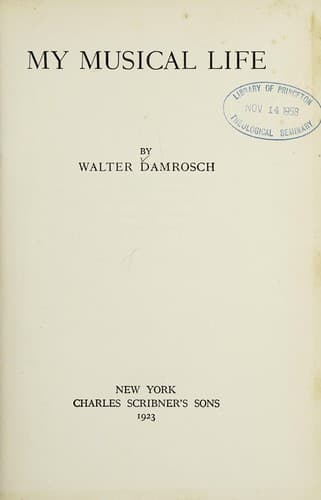
Conductors (Music) -- United States -- Biography; Damrosch, Walter, 1862-1950
Then began a summer of delights for me. Mr. Carnegie had a piper who,
according to old Scotch custom, would walk around the outer walls of the
house every morning to awaken us. My room was in the bachelor quarters
and had a little fireplace in which a peat fire smouldered comfortably.
The smell of peat and the sound of the piper as he drew nearer and
nearer to my window and then again receded in the distance are always
inseparably associated in my memory. In the mornings I usually worked at
my studies in counterpoint and composition, but from luncheon on it was
nothing but delightful entertainment or listening with keenest interest
to discussions of all kinds—political, economic, poetical. Miss Dodge
was a most stimulating person. She had a mind that would accept nothing
without analysis or proof, and the verbal duels between her and Mr.
Carnegie were fascinating, for, although she was not Scotch, she, as
much as Mr. Carnegie, typified the story of the two Scotsmen who meet
each other and one says: “Where are you going, Donald?” “Oh, just doon
to the village to contradict a wee.”
Occasionally I would accompany Mr. Carnegie to some lonely loch among
the hills to fish for trout, but I have never developed into a very
ardent disciple of Izaak Walton. I used to get more pleasure from lying
on my back watching the marvellous Scotch sky with its low-hanging
clouds framing the hills in their loving embrace, with perhaps now and
then just a speck of blue shining through, than from the catching of the
“finny monsters.” These, however, rarely measured over six inches in
length, although I certainly enjoyed them the following morning, when we
had them for breakfast, rolled in oatmeal flour and deliciously fried.
In the evenings I had to contribute my little quota toward the
house-party by playing Beethoven and Wagner on an excellent Broadwood
piano.
During all this time I was amazed at the extreme simplicity and
gentleness which characterized Mr. Blaine’s demeanor toward all with
whom he came in contact. Here was a man who at that time was the most
loved and the most execrated American, and yet he had in him absolutely
nothing of the “prima donna” manner of many of those in my profession
who have achieved fame. His dignity, however, was innate and
unconscious, and during the many years that I knew him and knew him
intimately I have never seen any one who dared to presume on his
simplicity and general cordiality of manner by undue familiarity. His
power of abstraction from his surroundings was remarkable. He enjoyed
working in the room in which his family were talking, laughing, and
disputing on all manner of subjects, while he would sit in a corner
concentrated on some problem of his own and work it out, absolutely
oblivious to what was going on about him.
The Blaine family left Cluny all too soon, and not only I, but the
entire household felt their absence keenly.
Public-domain text, read in full here on John Shaqi.
Reviews
Reviews
No reviews yet
Be the first to share your thoughts on this work.
Elsewhere in the archive
Join the Discussion
Join the discussion
Sign in to leave a comment or review.
Sign InorCreate an account