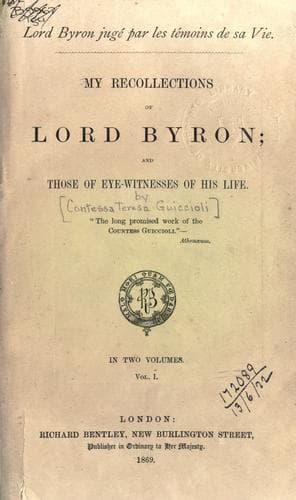
My Recollections of Lord ByronGuiccioli, Teresa, contessa di
General
My Recollections of Lord Byron
Guiccioli, Teresa, contessa di
Byron, George Gordon Byron, Baron, 1788-1824; Poets, English -- 19th century -- Biography
The epoch, however, of faint words and unbecoming silence has gone by
even in England. Already one of the greatest men of England has claimed
a monument in Westminster Abbey, which had been denied to his memory by
the bigoted rancor of the man who was dean at the time of Byron's death,
denied to that poet whom another great English statesman has called "a
great writer, but a still greater man."
There remains a still more imperious duty to be fulfilled by those who
have been able to appreciate his great qualities. That duty is to
proclaim them and to prevent the further spread of falsehood and error
as to his real character.
This is a very long letter, my dear count, but you know how long all
letters must be which are intended to refute opinions and to rectify
judgments. M. de Lamartine has the excellent habit of listening to your
advice, and that is why I have had at heart to let you know the truth
about Byron. The present work will adduce the proofs of the
appreciations contained in this letter. I know that you do not require
them, but also that the public does.
Pray accept, etc.----.
FOOTNOTES:
[Footnote 6: Galt says, "It was in the course of the passage to the
island of Zea, where he was put on shore, that one of the most emphatic
incidents of his life occurred; an incident which throws a remarkable
gleam into the springs and intricacies of his character, more perhaps
than any thing which has yet been mentioned. One day, as he was walking
the quarter-deck, he lifted an attaghan (it might be one of the
midshipmen's weapons), and unsheathing it, said, contemplating the
blade, '_I should like to know how a person feels after committing
murder_.' By those who have inquiringly noticed the extraordinary cast
of his metaphysical associations, this dagger scene must be regarded as
both impressive and solemn; the wish to know how a man felt after
committing murder does not imply any desire to perpetrate the crime. The
feeling might be appreciated by experiencing any actual degree of guilt;
for it is not the deed,--the sentiment which follows it makes the
horror. But it is doing injustice to suppose the expression of such a
wish dictated by desire. Lord Byron has been heard to express, in the
eccentricity of conversation, wishes for a more intense knowledge of
remorse than murder itself could give. There is, however, a wide and
wild difference between the curiosity that prompts the wish to know the
exactitude of any feeling or idea, and the direful passions that
instigate to guilty gratifications."--Galt, 152.
His curiosity was psychological and philosophical, that of a great
artist wishing to explore the heart of man in its darkest depths.
On the eve of his departure from Rome he assisted at the execution of
three assassins, remaining to the end, although this spectacle threw him
into a perfect fever, causing such thirst and trembling that he could
hardly hold up his opera-glass.
Public-domain text, read in full here on John Shaqi.
Reviews
Reviews
No reviews yet
Be the first to share your thoughts on this work.
Join the Discussion
Join the discussion
Sign in to leave a comment or review.
Sign InorCreate an account