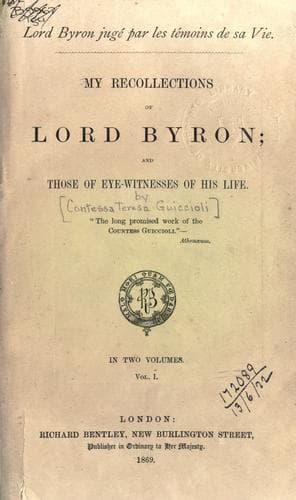
My Recollections of Lord ByronGuiccioli, Teresa, contessa di
General
My Recollections of Lord Byron
Guiccioli, Teresa, contessa di
Byron, George Gordon Byron, Baron, 1788-1824; Poets, English -- 19th century -- Biography
All this, no doubt, might have again called for his contempt, but on his
way from Ravenna to Pisa he wrote the outpourings of his mind in a poem,
the last lines of which are:--
"Oh Fame! if I e'er took delight in thy praises,
'Twas less for the sake of thy high-sounding phrases,
Than to see the bright eyes of the dear one discover,
The thought that I was not unworthy to love her.
"_There_ chiefly I sought thee, _there_ only I found thee;
Her glance was the best of the rays that surround thee;
When it sparkled o'er aught that was bright in my story,
I knew it was love, and I felt it was glory."
His heart was wounded by the persecutions to which those he loved were
subjected. His thoughts were for his daughter, who was growing up in the
midst of her father's enemies, and for his beloved sister who was
praying for him. He contemplated in the future the time when he could
show the moral and heroic power of his soul. He looked forward to the
great deeds by which he was going to astonish them, and perhaps call for
their admiration, instead of his writings, which had never reaped for
him any thing but pain.
"If I live," he wrote to Moore, "you will see that I shall do something
better than rhyming."
Truth however, when told by such men as Byron, and however ungraciously
received, must guide in the end the steps of those who walk in its wake.
This has been the case with Byron's poetry. Its influence over the minds
of Englishmen has been very salutary and great, and is one of the
principal causes which brought on a reform of the rooted prejudices and
opinions of the public in England, by the necessity under which it
placed them of looking into the defects of the law and of the
constitution, to which they had hitherto so crouchingly submitted. Since
then the feeling of good-will toward other nations has materially
increased in that great country.
Others have improved the way which Byron opened up for reform, and
thanks to him England at his death began to lose her excessive
susceptibility. She became accustomed to listen to the truth, and those
who now proclaim it are not required to be exiled, or to suffer as Byron
did up to the time of his death. His sufferings, no doubt, paved his way
to everlasting glory, but his heroic death left him at the mercy of the
enemies who survived him.
If ever a premature death was unfortunate, Byron's was; not only for
him, because he was on the point of giving to the world the proof of
those virtues which had been denied him, but also for humanity, by the
loss of various treasures which will probably never be found again.
Public-domain text, read in full here on John Shaqi.
Reviews
Reviews
No reviews yet
Be the first to share your thoughts on this work.
Join the Discussion
Join the discussion
Sign in to leave a comment or review.
Sign InorCreate an account