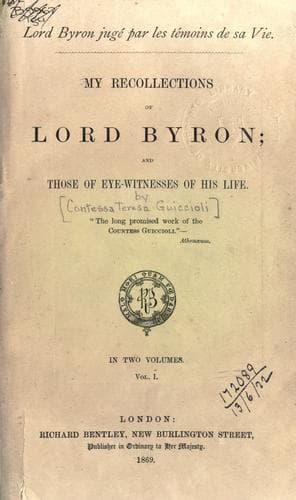
My Recollections of Lord ByronGuiccioli, Teresa, contessa di
General
My Recollections of Lord Byron
Guiccioli, Teresa, contessa di
Byron, George Gordon Byron, Baron, 1788-1824; Poets, English -- 19th century -- Biography
Not only would he have observed in his handsome face the denial of all
the absurd statements which had been made about him, but he would have
noticed a soul greater even than the mind, and superior to the acts
which he performed on this earth; he would have read in unmistakable
characters, not only what he was,--a good man,--but the promise of a
moral and intellectual perfection ever increasing. If this progressive
march toward perfection was at one time arrested by the trials of his
life, and by the consequences of undeserved sorrow, it was well proved
by his whole conduct toward the end of his life, and in the last poems
which he wrote. His poems from year to year assumed a more perfect
beauty, and increased constantly, not only in the splendor of their
conception, but also in the force of their expressions, and their moral
tendency, visible especially in his dramas. In them will be found types
surpassing in purity, in delicacy, in grandeur, in heroism, without ever
being untrue to nature, all that ever was conceived by the best poets of
England. Shakspeare, in all his master creations, has not conceived a
more noble soul than that of Angiolina, or a more tender one than
Marina's or even one more heroic than Myrrha's. As his genius became
developed, his soul became purified and more perfect. But the Almighty,
who does not allow perfection to be of this world, did not permit him to
remain on earth, when once he had reached that point. He allowed him,
however,--and this perhaps as a compensation for all the injuries which
he had suffered,--to die in the prime of life a death worthy of him; the
death of a virtuous man, of a hero, of a philosopher.
Excuse this long letter, for if I have ventured to speak to you at such
length of the moral, and--may I say the word?--"physical" beauty of the
illustrious Englishman, it is because one genius can appreciate another,
and that, in speaking of so great a man as Lord Byron, there is no fear
of tiring the listeners.
FOOTNOTES:
[Footnote 7: Among the bad portraits of Lord Byron spread over the
world, there is one that surpasses all others in ugliness, which is
often put up for sale, and which a mercantile spirit wishes to pass off
for a good likeness; it was done by an American, Mr. West,--an excellent
man, but a very bad painter. This portrait, which America requested to
have taken, and which Lord Byron consented to sit for, was begun at
Montenero, near Leghorn; but Lord Byron, being obliged to leave
Montenero suddenly, could only give Mr. West two or three sittings. It
was then finished from memory, and far from being at all like Lord
Byron, is a frightful caricature, which his family or friends ought to
destroy.]
[Footnote 8: Moore. vol. ii. p. 248.]
[Footnote 9: Miss E. Smith.]
CHAPTER III.
FRENCH PORTRAIT.
Public-domain text, read in full here on John Shaqi.
Reviews
Reviews
No reviews yet
Be the first to share your thoughts on this work.
Elsewhere in the archive
Join the Discussion
Join the discussion
Sign in to leave a comment or review.
Sign InorCreate an account