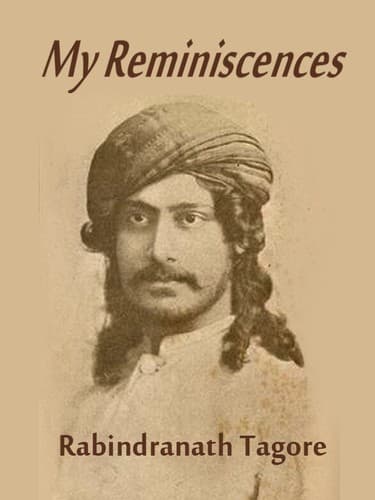
Authors, Bengali -- 20th century -- Biography; Tagore, Rabindranath, 1861-1941
Those who would dismiss this as sheer poetising would be wrong. The very
earth in spite of its having aged considerably surprises us occasionally
by its departure from sober stability; in the days of its youth, when
it had not become hardened and crusty, it was effusively volcanic and
indulged in many a wild escapade. In the days of man's first youth the
same sort of thing happens. So long as the materials which go to form
his life have not taken on their final shape they are apt to be
turbulent in the process of their formation.
This was the time when my brother Jyotirindra decided to start the
_Bharati_ with our eldest brother as editor, giving us fresh food for
enthusiasm. I was then just sixteen, but I was not left out of the
editorial staff. A short time before, in all the insolence of my
youthful vanity, I had written a criticism of the _Meghanadabadha_. As
acidity is characteristic of the unripe mango so is abuse of the
immature critic. When other powers are lacking, the power of pricking
seems to be at its sharpest. I had thus sought immortality by leaving my
scratches on that immortal epic. This impudent criticism was my first
contribution to the Bharati.
In the first volume I also published a long poem called _Kavikahini_,
The Poet's Story. It was the product of an age when the writer had seen
practically nothing of the world except an exaggerated image of his own
nebulous self. So the hero of the story was naturally a poet, not the
writer as he was, but as he imagined or desired himself to seem. It
would hardly be correct to say that he desired to _be_ what he
portrayed; that represented more what he thought was expected of him,
what would make the world admiringly nod and say: "Yes, a poet indeed,
quite the correct thing." In it was a great parade of universal love,
that pet subject of the budding poet, which sounds as big as it is easy
to talk about. While yet any truth has not dawned upon one's own mind,
and others' words are one's only stock-in-trade, simplicity and
restraint in expression are not possible. Then, in the endeavour to
display magnified that which is really big in itself, it becomes
impossible to avoid a grotesque and ridiculous exhibition.
When I blush to read these effusions of my boyhood I am also struck with
the fear that very possibly in my later writings the same distortion,
wrought by straining after effect, lurks in a less obvious form. The
loudness of my voice, I doubt not, often drowns the thing I would say;
and some day or other Time will find me out.
Public-domain text, read in full here on John Shaqi.
Reviews
Reviews
No reviews yet
Be the first to share your thoughts on this work.
Join the Discussion
Join the discussion
Sign in to leave a comment or review.
Sign InorCreate an account