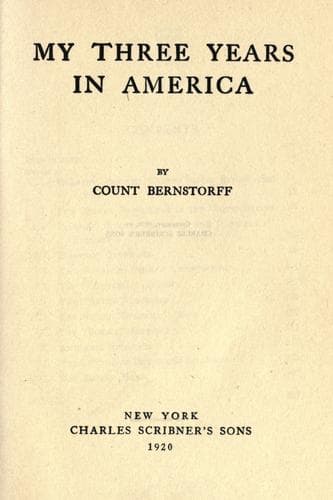
My Three Years in AmericaBernstorff, Johann Heinrich, Graf von
History
My Three Years in America
Bernstorff, Johann Heinrich, Graf von
Germany -- Foreign relations -- United States; United States -- Foreign relations -- Germany; World War, 1914-1918
The _Wilhelmina_ was taken by the English into Falmouth and detained
on the grounds that Hamburg was a fortified town, and that, according
to the measures adopted by Germany for supplying the civil population
with food--requisitioning, centralization of distribution, etc.--there
was no longer any distinction between the supply of the military
and the civil population. While the negotiations on this question
were still in the air, and seemed to be progressing favorably for
us, England resorted to a general blockade. Consequently the case
lost its interest, both practical and as a question of principle,
especially as England declared her readiness to pay for the goods
at Hamburg prices. As, on the other hand, insistence on the purely
theoretical claims would give rise to the danger that the English
or American secret service might in the end succeed in proving
the German origin of the undertaking, Herr Albert accepted the
proffered payment of the English Government, and received as
compensation a sum which covered all the expenses.
Such incidents could have been construed in several ways. One of
the most important, and also the most popular, was the shipment of
cotton to Germany for the civilian population between the autumn of
1915 and the middle of 1916. The declaration of cotton as absolute
contraband was at first only on paper, as no American exporters had
hitherto ventured to ship cotton. Consequently, detailed discussions
took place as to whether such an undertaking should be entered upon
in the full light of publicity. Great excitement among the cotton
growers proved the extremely keen and widespread interest. England
would have been forced to act on her declaration at a time when the
American Government could not afford to ignore the interests of the
cotton industry, with its influence on domestic politics. The full
effect of the meagreness of the crops, and on the other hand the
increase of consumption in the United States, and consequent rise
in price, was not yet realized by the public, nor even in cotton
circles. The cotton industry viewed with anxiety the increased
difficulty of finding a market, and were anxious for a reopening
of that of the Central Powers.
Public-domain text, read in full here on John Shaqi.
Reviews
Reviews
No reviews yet
Be the first to share your thoughts on this work.
Join the Discussion
Join the discussion
Sign in to leave a comment or review.
Sign InorCreate an account