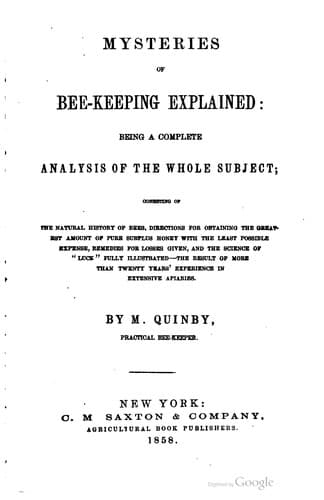
Mysteries of Bee-keeping ExplainedQuinby, M. (Moses)
Science
Mysteries of Bee-keeping Explained
Quinby, M. (Moses)
Bees
We will now return to the flowers, and see what few there are yet to
appear, after the middle of July. The button-ball bush (_Cephalanthus
Occidentalis_) is now much frequented for honey. Also, our vines,
melons, cucumbers, squashes, and pumpkins. The latter are visited only
in the morning, and honey is the only thing obtained; notwithstanding
the bee is covered with farina, it is not kneaded into pellets on its
legs. I have seen it stated that bees never get honey early in the
morning, but pollen instead. Now it is not best always to take our
word, who pretend to know all about it, but look for yourselves into
some of these matters. Take a look some warm morning, when the pumpkins
are in bloom, and see whether it is honey or pollen they are in quest
of. Also please make an observation when they are at work on the red
raspberry, motherwort, or catnip; you will thus ascertain a fact so
easily, that you will wonder any one with the least pretension to
apiarian science could be ignorant of it. I mention this, not because
it is of much importance in itself, but to show the fallibility of us
all, as we sometimes copy the mistaken assertions of others.
ADVANTAGES OF BUCKWHEAT.
Under some circumstances, clover will continue to bloom through this
part of the season; also, a few other flowers; but I find by weighing,
a loss from one to six pounds, between the 20th July and the 10th of
August, when the flowers of buckwheat begin to yield honey, which
generally proves a second harvest. In many places it is their main
dependence for surplus honey. It is considered by many an inferior
quality. The color, when separated from comb, resembles molasses of
medium shade. The taste is more pungent than clover honey; it is
particularly prized on that account by some, and disliked by others for
the same reason. In the same temperature it is a little thicker than
other honey, and is sooner candied.
AMOUNT OF HONEY COLLECTED FROM IT.
Swarms issuing as late as the 15th July, when they commence on
buckwheat, sometimes contain not over five pounds of stores, and yet
make good stocks for winter, whereas, without this yield, they might
not live through October. It fails about once in ten years. I have
known a swarm to gain in one week sixteen pounds, and construct comb to
store it at the same time. At another time I had a swarm issue the 18th
August, that obtained thirty pounds in about eighteen days. But such
buckwheat swarms, in ordinary seasons, seldom get over fifteen pounds.
The flowers last from three to five weeks. The time of sowing the grain
varies in different sections, from the 10th of June to the 20th July.
Farmers wish to give it just time to ripen before frost, as the yield
of grain is considered better, but as the time of frost is a matter of
guess-work, some will sow several days earlier than others. Whenever an
abundant crop of this grain is realized, a proportionate quantity of
honey is obtained.
DO BEES INJURE THE CROP?
Public-domain text, read in full here on John Shaqi.
Reviews
Reviews
No reviews yet
Be the first to share your thoughts on this work.
Elsewhere in the archive
Join the Discussion
Join the discussion
Sign in to leave a comment or review.
Sign InorCreate an account