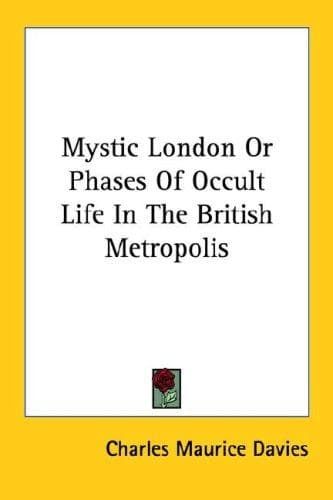
Mystic London; or, Phases of occult life in the metropolisDavies, Charles Maurice
History
Mystic London; or, Phases of occult life in the metropolis
Davies, Charles Maurice
London (England) -- Description and travel; London (England) -- Social life and customs -- 19th century; Occultism
I went--shall I confess it?--to the experience meeting rather inclined
to scoff, and I stopped, if not altogether to pray, at least to think
very seriously of the value of the instrumentality thus brought to
bear on such intractable material as the Kensal New Town population.
The more cumbrous, even if more perfect or polished, machinery of the
Established Church has notoriously failed for a long time to affect
such raw material; and if it is beginning to succeed it is really by
"taking a leaf out of the book" of such pastors as the one whose
Tea-and-Experience Meeting I had attended. "Palmam qui meruit ferat."
Stiggins element, I must, in all justice, say there was none. The pastor
was a simple but a refined and gentlemanly man; so was the poor broken
old minister. There was no symptom of raving or rant; no vulgarity or
bad taste. A gathering at a deanery or an episcopal palace could not
have been more decorous, and I doubt if the hymns would have been sung
as heartily. There was as little clerical starch as there was of the
opposite element. Rubbing off the angles of character was one of the
objects actually proposed by the pastor as the result of these
gatherings; and I really felt as though a corner or two had gone out of
my constitution. If a man is disposed to be priggish, or a lady
exclusive, in religious matters, I would recommend the one or the other
to avail themselves of the next opportunity to attend a
Tea-and-Experience Meeting at Kensal New Town.
CHAPTER X.
SUNDAY LINNET-SINGING.
There is something very Arcadian and un-Cockney-like in the idea of
linnet-singing in Lock's Fields. Imagination pictures so readily the
green pastures and the wild bird's song, and Corydon with his pipe and
his Phyllis, that it seems a pity to disabuse that exquisite faculty of
our nature so far as to suggest that the linnets of which we speak are
not wild, but tame and caged, and the fields very much less rural than
those of Lincoln's Inn. This was the announcement that drew me to the
New Kent Road on a recent Sunday morning to hear what poor Cockney Keats
called the "tender-legged linnets:" "Bird-singing.--A match is made
between Thomas Walker (the Bermondsey Champion) and William Hart
(Champion of Walworth) to sing two linnets, on Sunday, for _2l._ a side;
birds to be on the nail precisely at two o'clock; the host to be
referee. _10s._ is now down; the remainder by nine this evening, at the
Jolly Butchers, Rodney Road, Lock's Fields. Also a copper kettle will be
sung for on the same day by six pairs of linnets; first pair up at
half-past six o'clock in the evening. Any person requiring the said
room for matches, &c., on making application to the host, will
immediately be answered."
Public-domain text, read in full here on John Shaqi.
Reviews
Reviews
No reviews yet
Be the first to share your thoughts on this work.
Elsewhere in the archive
Join the Discussion
Join the discussion
Sign in to leave a comment or review.
Sign InorCreate an account