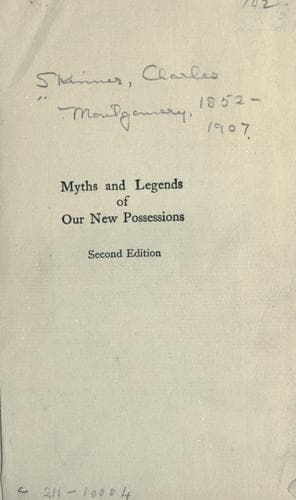
Myths & Legends of our New Possessions & ProtectorateSkinner, Charles M. (Charles Montgomery)
History
Myths & Legends of our New Possessions & Protectorate
Skinner, Charles M. (Charles Montgomery)
Tales -- Oceania; Tales -- West Indies
In one form or another the use of the weed was prevalent throughout
the Americas. Montezuma had his pipe after dinner, and rinsed his
mouth with perfume. For medicinal purposes snuff was taken through
a tube of bamboo, and tobacco leaves were chewed. The practice of
chewing also obtained to a slight extent among the natives as a
stay against hunger, and they are said to have indulged it in long
and exhaustive marches against an enemy. They would chew in battle,
because in a fight at close range they tried to squirt the juice
into the eyes of their foemen and blind them. The herb was taken
internally as a tea for medicinal reasons, was used as a plaster,
and was valued as a charm. Francisco Fernandez took it to Europe;
Drake and Raleigh introduced it in England, and though its use was
regarded as a sin, to be checked not merely by royal "counterblasts"
and by edicts like that of William the Testy, but by laws prescribing
torture, exile, whipping, and even death, it was not long in reaching
the uttermost parts of the earth.
Men of all races and conditions incline to the tradition of the
Susquehannas, that the plant was the gift of a benevolent spirit. In
their account this manitou had descended to eat meat, which they had
offered to her in a time of famine. As she was about to go back to
the skies she thanked them for their kindness, and bade them return
to the spot in thirteen months. They did so, and found maize growing
where her right hand had rested, beans at her left, and tobacco where
she had been seated.
The Indians of Guiana say that tobacco was given by a sea-goddess to a
man who was begging the gods to do something for him,--he didn't know
exactly what; he would merely like to have somebody do something for
him on general principles. As a divine gift, therefore, it was used
in certain of the rites of the Indians, and the man who wished to go
into a trance and see visions would starve for a couple of days, then
drink tobacco water. He generally saw the visions,--if he lived. In
some islands the priests inhaled the smoke of a burning powder and
thereupon fell into a stupor or a frenzy in which they talked with
the dead. Was this the smoke of tobacco, plus a little abandon, a
little falsehood, a little enthusiasm? Its enemies in King James's
time would have said that the smokers deserved not merely to talk
with the dead, but to join them.
The Two Skeletons of Columbus
Public-domain text, read in full here on John Shaqi.
Reviews
Reviews
No reviews yet
Be the first to share your thoughts on this work.
Join the Discussion
Join the discussion
Sign in to leave a comment or review.
Sign InorCreate an account