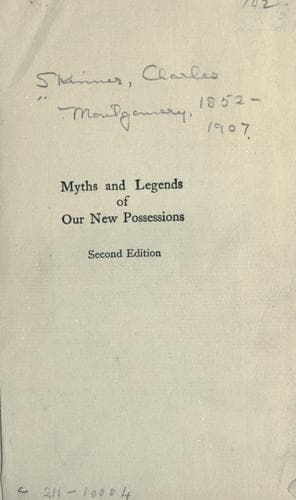
Myths & Legends of our New Possessions & ProtectorateSkinner, Charles M. (Charles Montgomery)
History
Myths & Legends of our New Possessions & Protectorate
Skinner, Charles M. (Charles Montgomery)
Tales -- Oceania; Tales -- West Indies
Following the return of the vanquished army of Spain to its home
country was another solemn voyage, undertaken for the transfer of the
bones of Christopher Columbus from the world he had discovered to the
land that grudgingly, cautiously permitted him to discover it. Spain
claimed all the benefits that arose from his knowledge, his bravery,
his skill, his energy, and his enthusiasm, and rewarded his years
of service with dismissal from office and confinement in chains as
a prisoner, but now it repented, and wished to house his unwitting
relics in state. Once before these bones had crossed the sea. After
the death of the great navigator, in Valladolid, Spain, in 1506,
his body remained in that city for seven years. Then it was taken
to Seville and placed in Las Cuevas monastery with that of his son,
Diego. In 1536 both bodies were exhumed and sent to Santo Domingo,
or Hispaniola, an island that Columbus appeared to hold in a warmer
liking than either of the equally picturesque, fertile, and friendly
islands of Cuba, Porto Rico, or Jamaica. In the quaint old cathedral
of Santo Domingo, built in 1514, the bodies of the great admiral,
his son, and also his grandson, Louis, first Duke of Veragua, rested
for more than a century without disturbance.
On the appearance of the English fleet, however, in 1655, the
archbishop was so fearful of a raid on the church and the theft of
the bodies that he ordered them to be hidden in the earth. During
the years in which they remained so covered the exact burial-place of
the admiral may have been forgotten, or, it may be, as several people
allege, that the San Dominicans tricked the Spaniards when, in 1795,
the latter gave their island to France and carried with them to Havana
the supposed skeleton of Columbus. Bones of somebody they certainly
did take, but it is no uncommon belief in the Antilles that the monks
of Santo Domingo had hidden the precious ones and sent to the monks
of Havana the bones of the son, Diego, albeit a monument was erected
to the memory and virtues of the great Columbus in Havana cathedral.
Public-domain text, read in full here on John Shaqi.
Reviews
Reviews
No reviews yet
Be the first to share your thoughts on this work.
Join the Discussion
Join the discussion
Sign in to leave a comment or review.
Sign InorCreate an account