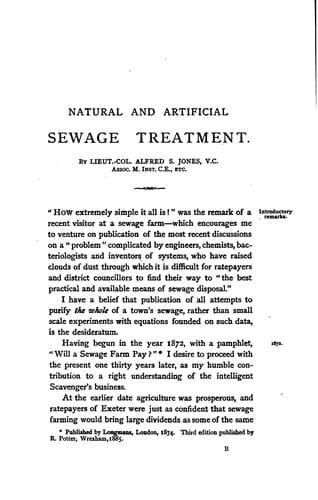
Natural & Artificial Sewage TreatmentJones, Alfred Stowell
Science
Natural & Artificial Sewage Treatment
Jones, Alfred Stowell
Sewage
“An examination of the residue obtained by evaporating large
quantities of open septic tank effluent (filtered through paper),
shows that the mineral matters largely consist of iron oxide,
from the decomposition of organic compounds of iron, and calcium
sulphate. Among the volatile constituents have been detected
ammonium carbonate, mercaptan-like compounds of very offensive
smell, acetic and butyric acids. No evidence of the presence of
amines could be found in the residue on evaporation, but by
distilling large volumes of the liquid and carefully analysing
the platinum salts obtained from the distillate, the presence of
amines is indicated.
“Research in this direction is being continued; careful
comparison especially will be made of the products obtained by
evaporation and distillation of crude sewage and septic tank
effluent respectively.
“The evidence, however, points to a breaking down of albuminoid
and cellulose matter in the septic tank into simpler and to some
extent volatile compounds. The reactions are probably hydrolytic
in character, ammonia, amines, carbonic acid, water, and possibly
alcohol, being produced.
“A further quantity of organic matter also disappears as methane,
nitrogen and hydrogen.”
[Sidenote: Must aerobic fermentation in all cases be preceded by
anaerobic fermentation?]
It will be clear from the foregoing, that the changes going on in a
septic tank are entirely different from those brought about in contact
beds, and the question whether a septic tank is a necessity for the
subsequent contact bed treatment, or whether it is a distinct
disadvantage, can only be definitely settled when we know whether
aerobic fermentation, i.e. decomposition, must in all cases be
preceded by anaerobic fermentation, i.e. putrefaction, and to what
extent, or whether such a succession of changes is not necessary.
[Sidenote: At Manchester contact beds accustomed to septic tank
effluent did not at once purify raw sewage.]
It is interesting to note in connection with this point, that during
the Manchester experiments it was established that contact beds, which
have become accustomed to septic tank effluent, will not at once
purify comparatively fresh sewage.
(_d_) _Velocity of Flow through Tank._—The velocity of flow through
the septic tank is of great importance, as on it depends the size of
the installation.
It seems to have become a habit to express this velocity by the length
of the sojourn of the sewage in the septic tank—for instance, “the
flow of sewage through the tank was such that it would fill it in
twenty-four hours”; but as all tanks vary in size, and as in
consequence the distance which has to be traversed by the sewage from
the entrance to the exit in twenty-four hours is different in nearly
every case, such a habit is, to say the very least, very misleading.
Public-domain text, read in full here on John Shaqi.
Reviews
Reviews
No reviews yet
Be the first to share your thoughts on this work.
Join the Discussion
Join the discussion
Sign in to leave a comment or review.
Sign InorCreate an account