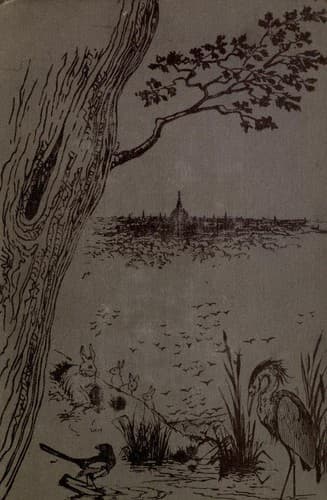
Country life -- England; Natural history -- Outdoor books; Nature study
These red cheeks want but the least motion to break into a smile; the
action of opening the lips to speak is sufficient to give that
expression. The fur cap he wears allows the round shape of his head to
be seen, and the thick neck which is the colour of a brick. He trudges
deliberately round the straw-rick: there is something in the style of
the man which exactly corresponds to the barn, and the straw, and the
stone staddles, and the waggons. Could we look back three hundred years,
just such a man would be seen in the midst of the same surroundings,
deliberately trudging round the straw-ricks of Elizabethan days, calm
and complacent though the Armada be at hand. There are the ricks just
the same, here is the barn, and the horses are in good case; the wheat
is coming on well. Armies may march, but these are the same.
When his waggon creaks along the road towards the town his eldest lad
walks proudly by the leader's head, and two younger boys ride in the
vehicle. They pass under the great elms; now the sunshine and now the
shadow falls upon them; the horses move with measured step and without
haste, and both horses and human folks are content in themselves.
As you sit in summer on the beach and gaze afar over the blue waters
scarcely flecked with foam, how slowly the distant ship moves along the
horizon. It is almost, but not quite, still. You go to lunch and return,
and the vessel is still there; what patience the man at the wheel must
have. So, now, resting here on the stile, see the plough yonder,
travelling as it were with all sails set.
Three shapely horses in line draw the share. The traces are taut, the
swing-tree like a yard braced square, the helmsman at the tiller bears
hard upon the stilts. But does it move? The leading horse, seen distinct
against the sky, lifts a hoof and places it down again, stepping in the
last furrow made. But then there is a perceptible pause before the next
hoof rises, and yet again a perceptible delay in the pull of the
muscles. The stooping ploughman walking in the new furrow, with one foot
often on the level and the other in the hollow, sways a little with the
lurch of his implement, but barely drifts ahead.
While watched they scarcely move; but now look away for a time and on
returning the plough itself and the lower limbs of the ploughman and
the horses are out of sight. They have gone over a slope, and are "hull
down"; a few minutes more, and they disappear behind the ridge. Look
away again and read or dream, as you would on the beach, and then, see,
the head and shoulders of the leading horse are up, and by-and-by the
plough rises, as they come back on the opposite tack. Thus the long
hours slowly pass.
Public-domain text, read in full here on John Shaqi.
Reviews
Reviews
No reviews yet
Be the first to share your thoughts on this work.
Join the Discussion
Join the discussion
Sign in to leave a comment or review.
Sign InorCreate an account