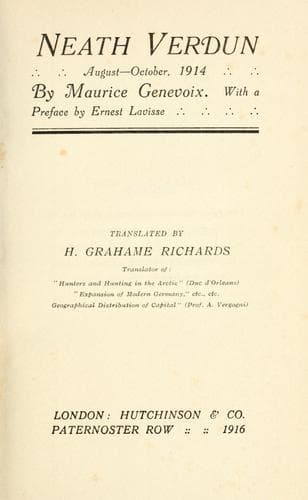
'Neath Verdun, August-October, 1914Genevoix, Maurice
History
'Neath Verdun, August-October, 1914
Genevoix, Maurice
Verdun, Battle of, Verdun, France, 1914
The night becomes black and corpses are no longer visible. But they
are always there, at the bottom of the ditches, on the slopes at the
very edge of the road. We realize their presence even in the dark. By
shielding the eyes and peering hard, it is possible to see the eerie
heaps which have lost all resemblance to that of which they are made.
Beyond all, one can smell them; the peculiar, indescribable stench is
heavy in the still evening air. The slowly moving breeze passing over
those bodies fills our noses and throats with the odour. It makes us
shudder instinctively, fearful lest that welter of putrefaction should
be communicated from them to us.
Not a word in the ranks; nothing but the regular tramp, tramp, before
and behind me; occasionally someone coughs, a little dryly, or a man
spits. That is all. It must be cold, yet my head and hands are
burning, and my will struggles to subdue an uncontrollable inclination
to turn to my right where the cool waters of the Aire, flowing by the
roadside, are betrayed by the stagnant pools under the trees.
An unexpected halt! The men bump their noses against the packs of the
file in front. Confusion and much swearing. Then quick commands:
"Quartermasters prepare rations for distribution."
It is the best of all signs. The day's march is ended. Yet for an hour
we are kept waiting on the road. The stench is worse than ever. There
are dead horses somewhere near here.
_Deuxnoux-devant-Beauzée._ We pass in turn before the ration-carts. By
the light of swinging lanterns I catch a glimpse of a bearded face,
the blade of a butcher's knife, at the end of a bare forearm, quarters
of meat, and the twinkling buttons of a greatcoat. The lantern dances
on its way; nothing remains but confused, restless forms.
Very soon, however, fires are leaping and glowing in the roadway
outside the houses. The cooks are bending over them, their
weather-hardened, highly coloured faces thrown into relief, while the
gigantic shadows they cast flit along the walls.
We mess in the house of a farmer's wife whose husband is on service.
This time last night she was waiting on German officers. She showed us
a plate containing the remains of some pickled cabbage, and exclaims:
"See, messieurs, they left such a lot behind them!"
She soon gets to work, and, propping a loaf against her ample bosom,
cuts off thick slices of new bread (new bread, mark you!). In another
moment our glasses are merry with cider brought from the cellar in a
stone jug at least two feet high.
"But are you quite sure," she asks, "that they won't return?"
I reply to her in a fashion that pleases her:
"Madam, you can bet your own child's cap upon it!"
We are well abed when there sounds a heavy knocking on the door of the
barn, which my men have already firmly closed.
"Pannechon! Pannechon! Come out, _mon vieux_!"
Pannechon is my orderly. I hear him emerging from the hay and
stumbling over sleepers who do not scruple to tell him what they think
of him.
Public-domain text, read in full here on John Shaqi.
Reviews
Reviews
No reviews yet
Be the first to share your thoughts on this work.
Join the Discussion
Join the discussion
Sign in to leave a comment or review.
Sign InorCreate an account