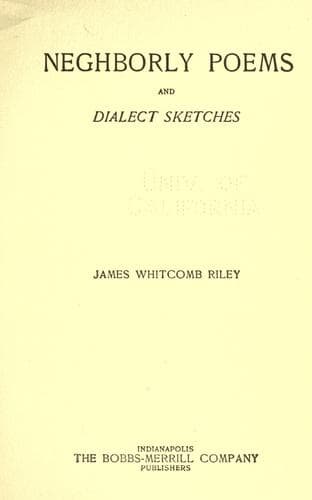
Neghborly Poems and Dialect SketchesRiley, James Whitcomb
General
Neghborly Poems and Dialect Sketches
Riley, James Whitcomb
Dialect literature, American; Dialect poetry, American
How different the mind and method of the true interpreter. As this
phrase goes down the man himself arises--the type perfect--Colonel
Richard Malcolm Johnston, who wrote "The Dukesborough Tales"--an
accomplished classic scholar and teacher, yet no less an accomplished
master and lover of his native dialect of middle Georgia. He, like
Dickens, permits his rustic characters to think, talk, act, and live,
just as nature designed them. He does not make the pitiable error of
either patronizing or making fun of them. He knows them and he loves
them; and they know and love him in return. Recalling Colonel
Johnston's dialectic sketches, with his own presentation of them from
the platform, the writer notes a fact that seems singularly to obtain
among all true dialect-writers, namely, that they are also endowed with
native histrionic capabilities: _Hear_, as well as read, Twain, Cable,
Johnston, Page, Smith, and all the list, with barely an exception.
Did space permit, no better illustration of true dialect sketch and
characterization might here be offered than Colonel Johnston's simple
story of "Mr. Absalom Billingslea," or the short and simple annals of
his like quaint contemporaries, "Mr. Bill Williams" and "Mr. Jonas
Lively." The scene is the country and the very little country town,
with landscape, atmosphere, simplicity, circumstance--all surroundings
and conditions--_veritable_--everything rural and dialectic, no less
than the simple, primitive, common, wholesome-hearted men and women who
so naturally live and have their blessed being in his stories, just as
in the life itself. This is the manifest work of the true dialect
writer and expounder. In every detail, the most minute, such work
reveals the master-hand and heart of the humanitarian as well as
artist--the two are indissolubly fused--and the result of such just
treatment of whatever lowly themes or characters we can but love and
loyally approve with all our human hearts. Such masters necessarily are
rare, and such ripe perfecting as is here attained may be in part the
mellowing result of age and long observation, though it can but be
based upon the wisest, purest spirit of the man as well as artist.
Public-domain text, read in full here on John Shaqi.
Reviews
Reviews
No reviews yet
Be the first to share your thoughts on this work.
Elsewhere in the archive
Join the Discussion
Join the discussion
Sign in to leave a comment or review.
Sign InorCreate an account