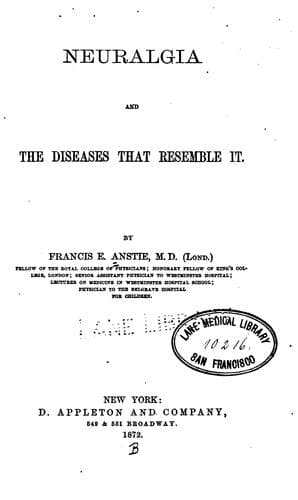
Neuralgia and the diseases that resemble it — John Shaqi
Neuralgia and the diseases that resemble itAnstie, Francis Edmund
Science
Neuralgia and the diseases that resemble it
Anstie, Francis Edmund
Neuralgia
(_e_) _Dorso-lumbar Neuralgia._--The superficial branches of the spinal
nerves emanating from the lumbar plexus are considerably less liable to
be affected with severe and well-marked neuralgia than are the
dorso-intercostal nerves. Pains in the abdominal walls, which are a good
deal like neuralgia, are not uncommon; but the majority of them will be
found, on careful observation, to be myalgia. At least, this has been
the case in my own experience.
When true neuralgia of the superficial branches of the lumbo-abdominal
nerves occurs, it develops itself in one or more of the following foci:
(1) Vertebral points, corresponding to the posterior branches of the
respective nerves; (2) an iliac point, about the middle of the crista
ilii; (3) an abdominal point, in the hypogastric region; (4) an inguinal
point, in the groin, near the issue of the spermatic cord, whence the
pain radiates along the latter; (5) a scrotal or labial point, situated
in the scrotum or in the labium majus.
Such is the description given by Valleix; for my own part, I cannot say
that I have seen enough cases to test its accuracy. I believe it to be
generally correct, yet it may fairly be doubted whether the author might
not have revised his description had the natural history of myalgic
affections been as carefully investigated as it has since been. The
hypogastric foci of pain of which he speaks are at least open to
considerable suspicion, as it will be shown, in the chapter on Myalgia,
that an extremely common variety of the latter affection is situated in
this region, and the severity of the pain which it often produces might
well cause it to be mistaken for a genuine neuralgia.
I have, however, seen three or four cases in which the very complete
intermittence of the paroxysms, without any perceptible relation to the
question of muscular fatigue, left no doubt in my mind of the really
neuralgic character of the malady. In one of these instances, oddly
enough, the exciting cause appeared to be fright; and this was as severe
a case as one often sees. The patient was a woman of middle age, and
much depressed by the long continuance of a profuse leucorrhoea. As
she was walking along the street, a herd of cattle, in a somewhat
irritable and disorderly condition, came suddenly toward her; she
immediately began to suffer pain just above the crest of the ilium, and
at the lumber region, and, most acutely, in the labium majus of one
side; and then pain returned daily, about 10 A. M., lasting for half an
hour with great severity. This woman's family history was remarkable:
her mother had been paraplegic, her sister was a confirmed epileptic,
and two of her children had suffered from chorea.
Public-domain text, read in full here on John Shaqi.
Reviews
Reviews
No reviews yet
Be the first to share your thoughts on this work.
Join the Discussion
Join the discussion
Sign in to leave a comment or review.
Sign InorCreate an account