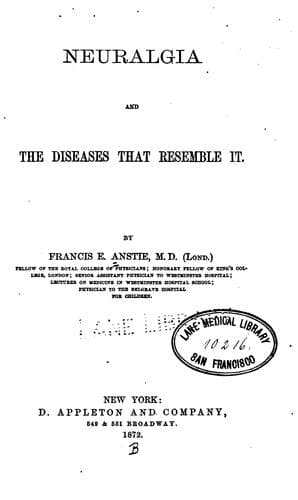
Neuralgia and the diseases that resemble itAnstie, Francis Edmund
Science
Neuralgia and the diseases that resemble it
Anstie, Francis Edmund
Neuralgia
Sciatica is a disease from which youth is comparatively exempt. Valleix
had collected one hundred and twenty-four cases, and in not one was the
patient below the age of seventeen, only four were below twenty. In the
next decade there were twenty-two; in the next, thirty; and the largest
number of cases, thirty-five, occurred between the ages of forty and
fifty. This completely tallies with my own experience, and appears to
afford some support to a suspicion I have formed, that the chief
exciting cause of sciatica is the pressure exercised on the nerve in
locomotion, and that this cause exercises its maximum influence when the
period of bodily degeneration commences. It is further remarkable that,
in elderly persons (whose habits of locomotion are of course more
limited), the proportion of fresh cases rapidly diminishes; and also
that above the age of thirty the number of male patients greatly exceeds
that of female patients attacked. All this seems to point in the same
direction.
According to my observation, there are three distinct varieties of
sciatica. The first of these is obscure in its origin, but may be said,
in general terms, to be connected with a nervous temperament of the
highly impressible kind, which is more or less like what we call
"hysteric," not only in the female, but also in male patients. The
subjects of this kind of sciatica are mostly young persons, and hardly
ever more than middle-aged; they are generally found to be liable to
other forms of neuralgia; and the actual attack of sciatica is produced
by some fatigue or mental distress, which at other times might have
brought on sick headache, or intracostal neuralgia, etc. Very many of
these patients are anæmic; and chlorotic anæmia seems specially to favor
the occurrence of the affection. The greater number of the victims are
females, and in very many, whether as cause or effect, there is impeded,
or at least imperfect, menstruation. This kind of sciatic pain is not
usually of the highest degree of intensity, but it generally spreads
into a great many branches, both in a direct and a reflex manner. It is
probable that this variety of the disease is, at least very often,
dependent upon, or much aggravated by, an excited condition of the
sexual organs; certainly, I have observed it with special frequency in
women who have remained single long after the marriageable age, and in
several male patients there has been either the certainty or a strong
suspicion of venereal excess. Sciatica of this kind also occurred in the
case of a single woman aged about thirty, who to my knowledge was
excessively addicted to self-abuse.
Public-domain text, read in full here on John Shaqi.
Reviews
Reviews
No reviews yet
Be the first to share your thoughts on this work.
Elsewhere in the archive
Join the Discussion
Join the discussion
Sign in to leave a comment or review.
Sign InorCreate an account