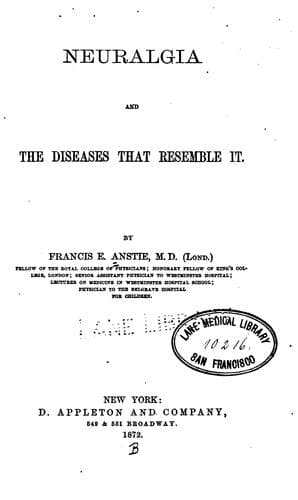
Neuralgia and the diseases that resemble itAnstie, Francis Edmund
Science
Neuralgia and the diseases that resemble it
Anstie, Francis Edmund
Neuralgia
Another circumstance which distinguishes the form of sciatica which we
are now describing is, the degree in which (above all other forms of
neuralgia) it involves paralysis of motion. [The subject of the
complication of neuralgia will be treated in a general manner farther
on; but it seems necessary to note here the special liability of sciatic
patients to this and to the most material complications]. By far the
largest part of the motor nervous supply for the whole lower limb passes
through the trunk of the great sciatic; it might therefore be naturally
expected that a strong affection of the sensory portion of the nerve
would produce, in a reflex manner, some powerful effect upon the motor
element. This effect is most frequently in the direction of paralysis.
Complete palsy is rare, but in a large proportion of cases which have
lasted some time there will be found, independently of any wasting of
muscles, a positive and considerable loss of motor power. It is of
course necessary to avoid the fallacy which might be produced by
neglecting to observe whether movement was restricted merely in
consequence of its painfulness. Not long since, I had occasion to test
the electric sensibility in a case of sciatica, in which there was
extremely severe pain, affecting chiefly the peroneal region of the leg,
and great weakness of the leg, amounting to inability for walking. The
gastrocnemius could hardly be got to contract at all, when the most
powerful Faradic current was directed upon the nerve in the popliteal
space of the affected limb, though the muscle of the sound side reacted
with great vigor.
_Anæsthesia_ is also a common complication of sciatica, far commoner, I
venture to think, than it has been represented either by Valleix, or
Notta. It is necessary, however, to be explicit on this point. In the
early stages, both of this form of sciatica, and of the milder variety
previously described, there is almost always partial numbness of the
skin previous to the first outbreak of the neuralgic pain, and during
the intervals between the attacks. By degrees this is exchanged, in the
milder form, for a generally diffused tenderness around the foci of
neuralgic pain, while other portions of the limb remain more or less
anæsthetic. In the severer forms it sometimes happens that, besides an
intense tenderness of the skin over the painful foci, there is diffused
tenderness over the greater part or the whole of the surface of the
limb. But it is important to remark that both in the anæsthetic and the
hyperæsthetic conditions (so called) the tactile sensibility is very
much diminished. I have made a great many examinations of painful limbs,
in sciatica, and have never failed to find (with the compass points)
that the power of distinctive perception was decidedly lowered.
Public-domain text, read in full here on John Shaqi.
Reviews
Reviews
No reviews yet
Be the first to share your thoughts on this work.
Elsewhere in the archive
Join the Discussion
Join the discussion
Sign in to leave a comment or review.
Sign InorCreate an account