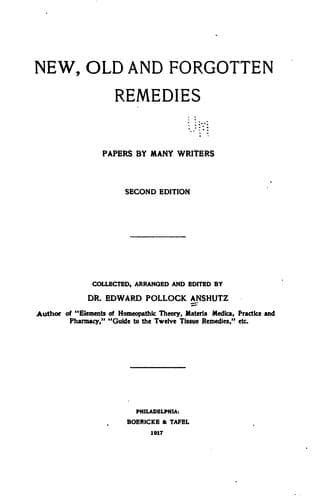
New, Old, and Forgotten Remedies: Papers by Many Writers
Science
New, Old, and Forgotten Remedies: Papers by Many Writers
Homeopathy -- Materia medica and therapeutics
When I am called upon to treat a patient suffering from an obstruction
of the bronchial tubes occasioned by mucus, which is frequently thick
and opaque and puriform--an obstruction extending to the delicate
bronchial ramification, and causing oppression more frequently than
cough, I turn my thoughts at once to _Bacillinum_. _Bacillinum_ is a
drug for old people, or, at any rate, for those whose lungs are old; for
those chronically catarrhal, or whose pulmonary circulation is enfeebled
without regard to the age of the subject; for those who have dyspnoea,
and who cough with difficulty from inaction of the respiratory ducts;
for the humid asthmatic, the bronchorrheal, who feel suffocated at
night; and, finally, for those who, after taking cold, are straightway
attacked with pulmonary congestion. Here, I believe, is the exact
sphere of action of _Bacillinum_ as a homoeopathic remedy.
_Bacillinum_ has been stigmatized as an unstable product. I consider
this reproach ill-founded. _Bacillinum_ is no more unstable than
_Psorinum_, which is an approved remedy in Homoeopathy. Typical
tuberculous lungs contain practically almost invariable elements. Do not
the microbes produced by cultivation and the animal extracts show any
variation in quality, and do they not change in the long run?
Like most homoeopathists who have made use of _Bacillinum_, I think it
is best given in the high dilutions and at long intervals. Dr. J.
Compton Burnett and Van der Berghe recommended the higher potencies--the
1000th, 100,000, etc., whereas I content myself with the 30th, which
satisfies every requirement. As regards the intervals which must elapse
between the doses, certain writers recommend from one to two weeks. In
acute cases I generally give six globules of _Bacillinum_ 30th every two
or three days; and in chronic cases of tuberculosis, etc., one dose
about twice a week.
We are no longer permitted to include in the same description the
tuberculosis of birds and that of mammals. Although the two bacilli, as
far as form and color are concerned, are absolutely identical, the
evolution of the two forms of tuberculosis presents characteristics so
different that we are forced to study them separately. At this day the
debate is a question of words, and experts discuss whether there are two
distinct genera or merely two different species.
Public-domain text, read in full here on John Shaqi.
Reviews
Reviews
No reviews yet
Be the first to share your thoughts on this work.
Join the Discussion
Join the discussion
Sign in to leave a comment or review.
Sign InorCreate an account