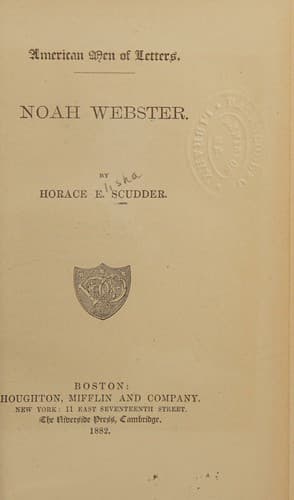
Noah Webster: American Men of LettersScudder, Horace Elisha
History
Noah Webster: American Men of Letters
Scudder, Horace Elisha
Educators -- United States -- Biography; Lexicographers -- United States -- Biography; Webster, Noah, 1758-1843
Alexander Hamilton was but a year older than Noah Webster, and was
indeed a much younger man when he first took part in the discussion of
public affairs. Hamilton was a man with a genius for statesmanship; in
Webster we see very significantly marks of political common sense, the
presence of which in the American mind at that day made Hamilton's
leadership possible. It would be hard to find a better illustration of
the average political education of Americans of the time than is shown
by Webster in this pamphlet and in other of his writings. We are
accustomed sometimes to speak of the Constitution as a half-miraculous
gift to the American people, and to look with exceptional reverence upon
the framers of that instrument. Well, that mind is on the whole quite as
sound as the contemptuous tone taken by Von Holst when he affirms that
"the Constitution had been extorted from the grinding necessity of a
reluctant people."[11] In these words, however, Von Holst himself
scarcely does justice to his own convictions, and they are rather an
extreme form of protest against an extravagant adulation of the
Constitution. Better instruments on paper have been drawn and applied to
conditions of society which were fatal to their efficacy; but the
calling of the convention, the framing of the Constitution, and the
final adoption were possible because in the community at large the ideas
of freedom and of self-government had already been formulated in local
institutions for generations, and for generations had been moulding the
character of the popular thought. The towns, the parishes, the boroughs,
of the early colonies were the inheritors of communal ideas which had
filtered from Germanic free communities through English parishes; under
the favoring conditions of a new world and its unchecked enterprise they
had become political units of great integrity. The colonies, with their
local government, modified rather than controlled by royal or
proprietary influence, had already learned many lessons of autonomy: the
period of the war had confirmed these several powers, and the conclusion
of the war found them still in possession of their interior organic
life, and lacking only that sovereignty which they had resisted and
overthrown. But the state life was incomplete: there was an absence of a
solid sovereignty in which the States could rest, and the political
thought of the independent colonies required for its final fulfillment
the depositary of national consciousness which the King and Parliament
had been, but could no longer be. It was the working out of this
practical political thought which issued in the Constitution and central
government, and it was possible to be worked out only because there had
been generations of Americans trained in political life.
Public-domain text, read in full here on John Shaqi.
Reviews
Reviews
No reviews yet
Be the first to share your thoughts on this work.
Join the Discussion
Join the discussion
Sign in to leave a comment or review.
Sign InorCreate an account