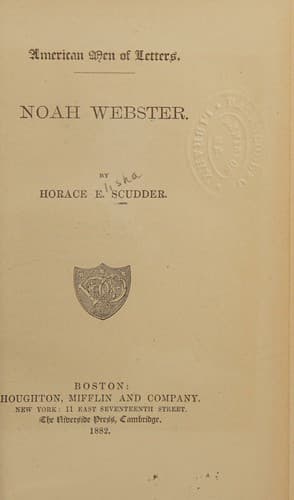
Noah Webster: American Men of LettersScudder, Horace Elisha
History
Noah Webster: American Men of Letters
Scudder, Horace Elisha
Educators -- United States -- Biography; Lexicographers -- United States -- Biography; Webster, Noah, 1758-1843
Webster was one of these men. He was the product of the forces which had
been at work in the country from the earliest days. English freedom,
which had forced its ways to these shores, had grown and increased under
the fostering care of self-government and native industry. He had been
born and brought up in a New England country village, the type of the
freest and most determinate local government; he had been educated at a
democratic college; he had shouldered his musket in a war for the
defense not of his State alone, but of his country, vague and ill
defined though its organic form might be. When, therefore, the war was
over, and the country was free and compelled to manage its own affairs,
he was qualified to take part in that management, and his temper led him
to look for fundamental grounds of conduct.
His "Sketches of American Policy" thus interests us as the political
thinking of a young American, of lively disposition, candid mind, and
rash confidence. It could not help being a reflection of other
literature and thought; but its best character is in its sturdy and
resolute assertion of English freedom as requiring a central authority
in which to rest. It is curious, in the opening pages, to see how, in
his theories of government, he is led away by the popular and alluring
philosophy of Rousseau and Rousseau's interpreter, Jefferson. When he
undertakes to explain the rationale of government he is a young man,
captivated by the current mode; when he reaches the immediate, practical
duty he is an Englishman, speaking to the point, and lighting upon the
one unanswerable demand of American political life at the time. In the
earlier pages of his "Sketches" he lays down his Theory of Government,
which is, in brief, that of the _contrat social_, but presented in a
homely form, which brings it nearer to the actual life of men; he
concludes his observation with a definition of the most perfect
practicable system of government as "a government where the right of
_making_ laws is vested in the greatest number of individuals, and the
power of _executing_ them in the smallest number." "In large
communities," he adds, "the individuals are too numerous to assemble for
the purpose of legislation: for which reason, the people appear by
substitutes or agents,--persons of their own choice. A representative
democracy seems, therefore, to be the most perfect system of government
that is practicable on earth." He finds no such government on the
Continent of Europe, or in history; but when he comes to America he
views with satisfaction a state of things which renders possible the
actual fulfillment of his ideal. "America, just beginning to exist, has
the science and the experience of all nations to direct her in forming
plans of government." There is an equal distribution of landed property,
freed from the laws of entail and primogeniture; there is no standing
army, and there is freedom from ecclesiastical tyranny; education is
Public-domain text, read in full here on John Shaqi.
Reviews
Reviews
No reviews yet
Be the first to share your thoughts on this work.
Join the Discussion
Join the discussion
Sign in to leave a comment or review.
Sign InorCreate an account