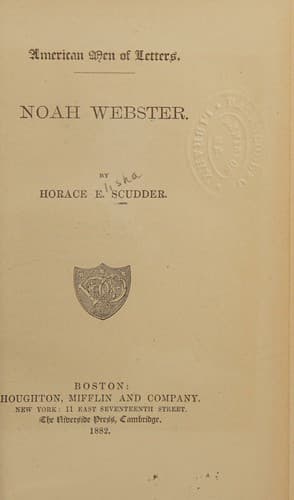
Noah Webster: American Men of LettersScudder, Horace Elisha
History
Noah Webster: American Men of Letters
Scudder, Horace Elisha
Educators -- United States -- Biography; Lexicographers -- United States -- Biography; Webster, Noah, 1758-1843
States cannot be said to be _united_ till such a principle is adopted in
its utmost latitude. If a single town or precinct could counteract the
will of a whole State, would there be any government in that State? It
is an established principle in government that the will of the minority
must submit to that of the majority; and a single State or a minority of
States ought to be disabled to resist the will of the majority, as much
as a town or county in any State is disabled to prevent the execution
of a statute law of the legislature. It is on this principle, and _this
alone_, that a free State can be governed; it is on this principle alone
that the American States can exist as a confederacy of republics. Either
the several States must continue separate, totally independent of each
other, and liable to all the evils of jealousy, dispute, and civil
dissension,--nay, liable to a civil war, upon any clashing of
interests,--or they must constitute a general head, composed of
representatives from all the States, and vested with the power of the
whole continent to enforce their decisions. There is no other
alternative. One of these events must inevitably take place, and the
revolution of a few years will verify the prediction."
In answering possible objections to the scheme, he rests in the power of
the people, who "forever keep the sole right of legislation in their own
representatives, but divest themselves wholly of any right to the
administration." He refuses to believe that there is any danger from
centralization so long as the people use the power which is vested in
them. "These things," he concludes, "demand our early and careful
attention: a general diffusion of knowledge; the encouragement of
industry, frugality, and virtue; and a sovereign power at the head of
the States. _All_ are essential to our peace and prosperity, but on an
energetic continental government principally depend our tranquillity at
home and our respectability among foreign nations. We ought to
generalize [that is, delocalize] our ideas and our measures. We ought
not to consider ourselves as inhabitants of a particular State only, but
as _Americans_, as the common subjects of a great empire. We cannot and
ought not wholly to divest ourselves of provincial views and
attachments, but we should subordinate them to the general interests of
the continent. As a member of a family every individual has some
domestic interests; as a member of a corporation he has other interests;
as an inhabitant of a State he has a more extensive interest; as a
citizen and subject of the American empire he has a national interest
far superior to all others. Every relation in society constitutes some
obligations, which are proportional to the magnitude of the society. A
good prince does not ask what will be for the interest of a county or
small district in his dominions, but what will promote the prosperity of
his kingdom. In the same manner, the citizens of this New World should
Public-domain text, read in full here on John Shaqi.
Reviews
Reviews
No reviews yet
Be the first to share your thoughts on this work.
Join the Discussion
Join the discussion
Sign in to leave a comment or review.
Sign InorCreate an account