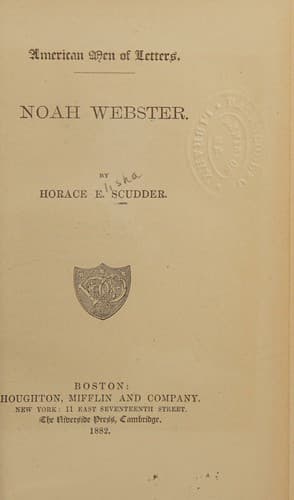
Noah Webster: American Men of LettersScudder, Horace Elisha
History
Noah Webster: American Men of Letters
Scudder, Horace Elisha
Educators -- United States -- Biography; Lexicographers -- United States -- Biography; Webster, Noah, 1758-1843
in the Northern States are experienced by the men who labor; in the
Southern States this is not the case among the slaves, who make a great
proportion among the laborers. It is of little consequence to a slave
whether his master employs in business ten thousand or one thousand, or
whether he gets four dollars or two for a hundred of tobacco. In both
cases he plods on at his task with the same slow, reluctant pace. A
_freeman_, on the other hand, labors with double diligence when he gets
a high price for his produce; and this I apprehend to be a principal
cause which has in the last two years occasioned such a surprising
difference of exports in favor of the Northern States."
Webster's connection with the "Minerva" continued for about five years,
when he abandoned it as unprofitable; but his industry may be inferred
from the fact that his writings upon the paper, inclusive of
translations from foreign languages, would amount to twenty octavo
volumes.
His withdrawal from the conduct of a daily newspaper did not mean his
indifference to public affairs. Near the close of his stay in New York
he wrote "A Letter on the Value and Importance of the American Commerce
to Great Britain, addressed to a Gentleman of Distinction in London."
His aim was to emphasize the judgment that the commercial interests of
the two countries were closely interwoven, and that in the complication
of European politics the United States, if compelled to make any
alliance, was most naturally related to England. In 1802 he published
his laborious and learned "Essay on the Rights of Neutral Nations," in
which he took a position at variance on a single point with that which
he held when vindicating Jay's Treaty a few years before. In that treaty
Great Britain had stipulated that naval stores should be prohibited as
contraband of war, and Webster, in common with others, assumed with
reluctance that such prohibition was in accordance with the general law
of nations, although admitting that this was the most vulnerable article
of the treaty. Further investigation satisfied him of his error, and he
frankly avowed it in the later essay, where he says: "For the honor of
my country, and the essential interests of her commerce, I regret that
the administration, in the very commencement of the national government,
has consented to abandon ground which the nations of Europe had, for
more than a century, been struggling to obtain and to fortify. I have no
hesitation in declaring that no considerations of public danger can
justify a commercial nation in consenting to enlarge the field of
contraband; nor can there be an apology for the renewal of the clause in
the compact, by which our true interests and essential rights have been
surrendered." Following the maxim that "Free ships make free goods," he
establishes himself on the proposition that "neutrals have a better
right to trade than nations have to fight and plunder." Webster argued
Public-domain text, read in full here on John Shaqi.
Reviews
Reviews
No reviews yet
Be the first to share your thoughts on this work.
Elsewhere in the archive
Join the Discussion
Join the discussion
Sign in to leave a comment or review.
Sign InorCreate an account