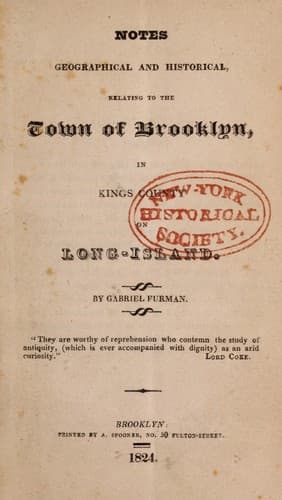
Notes Geographical and Historical, Relating to the Town of Brooklyn in Kings County on Long-IslandFurman, Gabriel
History
Notes Geographical and Historical, Relating to the Town of Brooklyn in Kings County on Long-Island
Furman, Gabriel
Brooklyn (New York, N.Y.) -- History
Mr. Solinus’ salary was 600 guilders per annum, equal to $200. Three
hundred guilders of which was to be paid by Brooklyn, and three hundred
by Father land, (Holland). Some time after, the inhabitants of Brooklyn
objected to raising their proportion of the salary; and May 25, 1662,
petitioned the Governor, that Mr. Solinus should reside among them;
setting forth as a reason, that if their minister resided with them more
people would go to church, and they would be better able to raise the
salary. Governor Stuyvesant, in order to accommodate this dispute,
proposed to pay 250 guilders towards Mr. Solinus’ salary, on condition
that he would preach in the Bouwery on Sunday afternoons.--This
arrangement appears to have been entered into, for a short time after
Mr. Solinus preached at the Bouwery half the time.
The Indians having on the 7th of June, 1663, attacked the town of
Esopus, burnt the same, and destroyed many of the inhabitants, and took
many prisoners; the event was communicated by Governor Stuyvesant to the
church at Brooklyn, in the following manner.
“As a sorrowfull accident and wilfull masacre has been committed by the
Esopus Indians, who have with deliberate design under the insidious
cover of friendship, determined to destroy Esopus, which they effected
or the 7th instant, killing and wounding a number of the inhabitants,
and taking many prisoners, burning the new town, and desolating the
place. Whereupon the congregation is directed and desired by his
Excellency the Governor General to observe and keep the ensuing
Wednesday as a day of fasting, humiliation and prayer to the Almighty,
hoping that he may avert further calamities from the New-Netherlands,
and extend his fatherly protection and care to the country. And it is
further ordered, that the first Wednesday in every month be observed in
like manner. By order of the Director General, and Council, &c. Dated at
Fort Orange, June 26, 1663.” Wednesday the 4th of July, 1663, was
observed as a day of thanksgiving on account of a treaty of peace
having been made with the Esopus Indians, and the release of the
inhabitants who had been taken prisoners; and also for the success
obtained over the British, who attempted with flying colours to take
possession of all Long-Island for the King of England, which was
prevented by the timely arrival of the Dutch fleet.
On the 23d of July, 1664, the Rev. Henry Solinus took leave of his
congregation and sailed in the ship Beaver for Holland. After his
departure, Charles Debevoise, the schoolmaster of the town, and sexton
of the church, was directed to read prayers, and a sermon from an
approved author, every Sabbath day in the church, for the improvement of
the congregation, until another minister was called.
Public-domain text, read in full here on John Shaqi.
Reviews
Reviews
No reviews yet
Be the first to share your thoughts on this work.
Join the Discussion
Join the discussion
Sign in to leave a comment or review.
Sign InorCreate an account