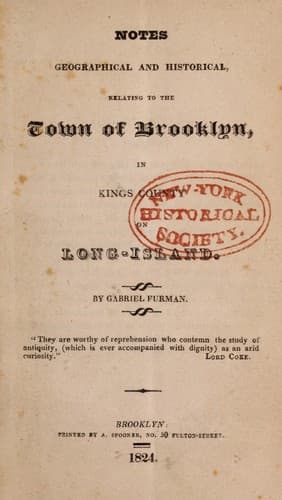
Notes Geographical and Historical, Relating to the Town of Brooklyn in Kings County on Long-IslandFurman, Gabriel
History
Notes Geographical and Historical, Relating to the Town of Brooklyn in Kings County on Long-Island
Furman, Gabriel
Brooklyn (New York, N.Y.) -- History
In 1685, a Windmill was erected in this town by John Vannise and Peter
Hendricks, for Michael Hainell. There is great reason to believe that
this was the first mill erected in this town. August 19, 1689, an
agreement was entered into between Cornelius Seberingh of Brookland, and
John Marsh of East Jersey, relative to building a water mill on
Graver’s kill in this town. At present there are in this town seven
water mills and two wind mills.--From February 16, 1823, to February 15,
1824, 5825 barrels of superfine flour, 260 barrels of fine flour, and
124 hogsheads of corn meal were inspected in this county. The most, if
not all of which flour and meal was manufactured at the mills in this
place.
SCHOOLS, NEWS-PAPERS, AND MORAL CHARACTER.
May 1661, Charles Debevoice was recommended by Gov. Stuyvesant as a
suitable person for schoolmaster of this town, and also for clerk and
sexton of the church, who was employed and received a good salary.
Immediately previous to the revolutionary war, that part of the town of
Brooklyn which is now comprised in the bounds of the village, and for
some distance without those bounds, supported but one school, of 19
scholars, five of whom were out of the family of Mr. Andrew Patchen. The
school-house was situated on the hill, on property which was then owned
by Israel Horsfield, but now belongs to the heirs of Carey Ludlow,
deceased.--The teacher was Benjamin Brown, a staunch whig from
Connecticut.
_District School, No. 1._ This school was organized at a public meeting,
held Jan. 2, 1816, at which meeting Andrew Mercein, John Seaman, and
Robert Snow were elected trustees, and John Doughty clerk of the school.
The trustees were appointed a committee to ascertain a proper site for
building a school-house, and report the probable expense thereof. At a
meeting held January 12, 1816, the trustees reported that they could
purchase four lots of ground on Concord street, of Mr. Noah Waterbury,
for $550. The meeting thereupon resolved, that “the sum of $2000 should
be raised by tax on the inhabitants of the said district, to purchase
said lots and to build a school-house thereon;” and that in the mean
time the “Loisian school be the common school of the said district;” and
that “the trustees of the district be authorized to exonerate from the
payment of teacher’s wages all such poor and indigent persons as they
shall think proper, pursuant to the act of the legislature;” and that
“it be recommended by this meeting, that the common school to be taught
in this district, be on the Lancastrian plan of instruction.”
In the school of this district, which includes the village of Brooklyn,
upwards of 200 children are taught. The price of tuition does not exceed
four dollars per annum, and from that amount down to nothing, in
proportion to the abilities of the parent. The School District No. 1, at
present contains 1607 children between the ages of 5 and 15 years, of
whom 1157 go to the public or private schools.
Public-domain text, read in full here on John Shaqi.
Reviews
Reviews
No reviews yet
Be the first to share your thoughts on this work.
Elsewhere in the archive
Join the Discussion
Join the discussion
Sign in to leave a comment or review.
Sign InorCreate an account