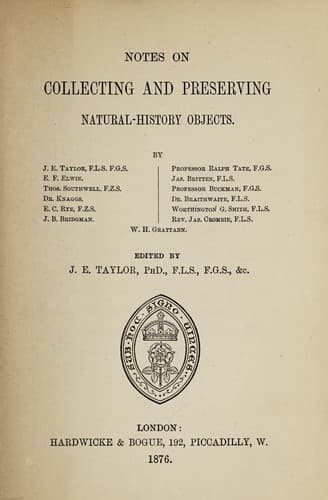
Notes on Collecting and Preserving Natural-History Objects
Science
Notes on Collecting and Preserving Natural-History Objects
Botanical specimens -- Collection and preservation; Zoological specimens -- Collection and preservation
Delicately as grasses are formed, yet it cannot be said that their
tissues are so liable to injury, or their colours so evanescent, as
those of the flowering plants which the botanist ordinarily delights
in. Nor indeed are the grasses so succulent as many other herbs. In
this respect they may be said to hold a place between ferns and those
plants which usually are called flowers.
Again, in the dried state their organs are generally so well preserved
as to present all that a botanist can wish for, for identification
as well as arrangement; and the student of grasses ever finds his
collection to contain beauties not only in point of rarity, but as
regards delicacy of structure and grace of outline.
Viewing them in this light alone, we have often been astonished that
so many students of plants pay so little attention to them, and this
feeling is enhanced when the great value of the grasses is considered.
If then a few simple directions for preserving these plants shall have
the effect of winning a convert to these views, we shall be delighted;
and to this end we shall make our descriptions as plain as our process
has ever been easy and simple, and yet complete.
In collecting grasses, as in other tribes of plants, it will be
necessary that our specimens should be chosen with the view to exhibit
every feature of interest. With this aim, then, it will be best in the
general way to obtain as much of the plant as possible, so that it
may be necessary to get them up by the roots. Still, in many species
the root is not of much importance: but there are a few which possess
rhizomata, or underground stems; such as the _Triticum repens_, _Poa
pratensis_, _P. compressa_, _Holcus mollis_, _Agrostis stolonifera_,
and others. These should always exhibit these parts; and as such
examples are usually agrarian, it is easier to mark down desirable
specimens and seek a fork at the neighbouring farm-buildings wherewith
to completely get them out, than to carry any substitute in a smaller
and less perfect implement.
Haying made these remarks, we will suppose that we are now about to
sally forth in search of grasses; in which case we make the following
preparations.
As we do not file our copy of the 'Times' we make use of it as
collecting-paper as follows:--Each side of the paper is cut in two,
or, as a Cockney would say, "in half." Each half is then folded into
a double collecting-sheet, and as many of these are taken as are
likely to be useful. In each of these papers is put a small slip of
writing-paper, on which to note the locality and any other noteworthy
fact connected with a specimen when put in the paper. These papers,
separately folded, are placed with the open ends inwards in a
convenient portfolio, and the collector is ready to take the field.
Public-domain text, read in full here on John Shaqi.
Reviews
Reviews
No reviews yet
Be the first to share your thoughts on this work.
Join the Discussion
Join the discussion
Sign in to leave a comment or review.
Sign InorCreate an account