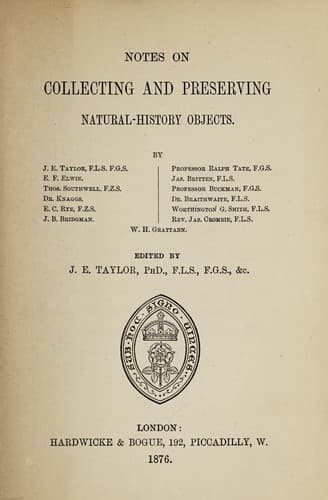
Notes on Collecting and Preserving Natural-History Objects
Science
Notes on Collecting and Preserving Natural-History Objects
Botanical specimens -- Collection and preservation; Zoological specimens -- Collection and preservation
_Collecting._--The bryologist has one advantage over the phænogamous
botanist, for it is not imperative that mosses should be laid out and
pressed immediately; and hence less care is required in collecting
them, than is bestowed on flowering plants; the necessary apparatus is
confined to a pocket-knife, to remove specimens from stones or trees,
a stock of stout waste paper, and a vasculum, or, better still, a
strong bag, in which to carry the packets. When collecting the plants,
it is well to remove any superfluous earth or stones, or to squeeze
out the water from those found in bogs; and then each is to be wrapped
separately in paper, and the locality marked outside; or the more
minute species may, for greater safety, be placed in chip boxes. On
reaching home, if we do not prepare the specimens at once, we must
not leave the parcels packed together in their receptacle, or mould
will soon attack them and spoil the whole; but we must spread them out
on the floor until quite dry, and then reserve them to a convenient
opportunity to lay out; as in the dry state they may be kept for years
unchanged.
It often happens that our line of study is developed by some fortuitous
circumstance. A neglected flowerpot in the corner of the garden
attracts attention by its verdant carpet of moss, or, peeping over the
wall, we see the crevices between the bricks bristling with capsules of
_Tortula muralis_, the red twisted peristome freshly brought to view
by the falling away of the lid, and, taking a bit indoors to submit to
the microscope, we are so captivated therewith that we then and there
determine to become a bryologist. Nor is this all that a journey round
the garden will disclose: the neglected paths yield other species not
less worthy of examination, and old apple-trees are not unfrequently
tenanted by mosses.
Extending our walks to the commons, lanes, and woods, we may find on
the ground and banks, in bogs and on the stumps and trunks of trees, a
number of species greatly extending our list; while others again are
only met with on the clay soil of stubble-fields, as various species of
_Pottia_ and _Ephemerum_: appearing in October, their delicate texture
is developed by the constant moisture of winter, and with it also they
vanish, to appear no more until the succeeding season. Travelling yet
farther away, we find that each locality we visit yields some novelty:
old walls and rocks of sandstone or slate, limestone districts, and,
above all, a mountainous country, are rich in species we seek in vain
elsewhere. Here peat bogs, and rocks dripping with water, ever supplied
by the atmosphere, or the tumbling streams everywhere met with, are the
chosen homes of these little plants, and thither must the collector
resort, if he would reap his richest harvest. Winter and spring in the
lowlands, and a later period in the elevated districts, will be found
most productive of fruiting plants.
Public-domain text, read in full here on John Shaqi.
Reviews
Reviews
No reviews yet
Be the first to share your thoughts on this work.
Join the Discussion
Join the discussion
Sign in to leave a comment or review.
Sign InorCreate an account