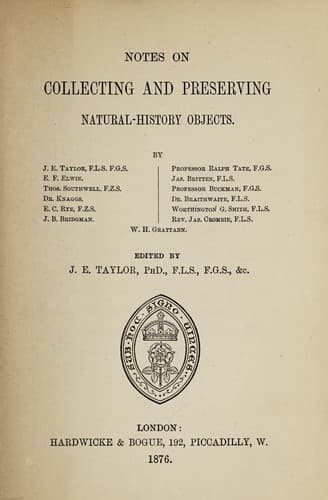
Notes on Collecting and Preserving Natural-History Objects
Science
Notes on Collecting and Preserving Natural-History Objects
Botanical specimens -- Collection and preservation; Zoological specimens -- Collection and preservation
2. In mounting specimens for the herbarium we must be guided by the
limits which we have fixed on for the extent of the same; and I may
first describe the method adopted for my own collection. Every
species has a separate leaf of cartridge-paper measuring 14-1/2 ×
10-1/2 inches, and on this the specimens are fixed, each mounted by
a little gum on a piece of toned paper; thus 4 or 6 to 12 specimens,
according to size, are attached to each leaf,--varieties have one
or more additional leaves; and to each is also fixed a triangular
envelope, inclosing loose capsules and leaves for ready transfer to the
microscope, and also a label indicating the name, habitat, and date of
collection. A pink cover for each genus includes the species, and a
stout millboard cover embraces the genera of each family, with the name
of which it is labelled outside, the whole shutting up in a cabinet.
Another form is that seen in Rabenhorst's Bryotheca Europæa, quarto
volumes of 50 specimens, one occupying each leaf, and so arranged that
the specimens do not come opposite to each other. Others again use
loose sheets of note-paper, within each of which a single specimen
is mounted; but this, from their size, is very cumbersome. Or we may
take a single well-chosen typical specimen and arrange many species
on a page, as is seen in the beautiful volume of Gardiner's 'British
Mosses' or McIvor's 'Hepaticæ Britannicæ.' Whatever plan we adopt, our
specimens, once well dried and kept in a dry place, are unchangeable,
and are always looked upon with pleasure, each recalling some pleasing
associations, or perchance reminding us of some long-lost friend, in
companionship with whom they were collected or studied. A stock of
duplicates must also be reserved, from which to supply our friends, or
exchange with other collectors for desiderata in our own series: these
may be kept in square cases of various sizes, cut so as to allow the
edges of the top and sides to wrap over the other half folded down on
the specimens.
The Hepaticæ of the family Jungermanniaceæ are treated precisely
as mosses, the capsules, however, show but little diversity, and
will not require separate preservation; but the elaters, or spiral
threads accompanying the seeds, are elegant microscopic objects. The
Marchantiaceæ must be pressed when fresh, as they do not revive with
the same facility as other species, owing to their succulent nature and
numerous layers of cells.
Public-domain text, read in full here on John Shaqi.
Reviews
Reviews
No reviews yet
Be the first to share your thoughts on this work.
Elsewhere in the archive
Join the Discussion
Join the discussion
Sign in to leave a comment or review.
Sign InorCreate an account