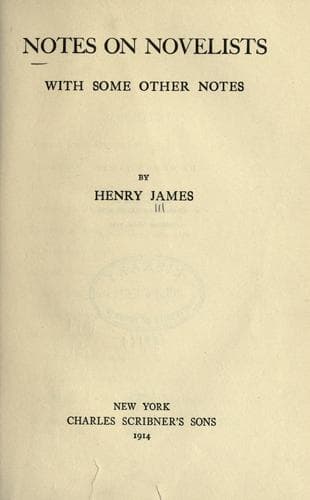
Notes on Novelists, with Some Other NotesJames, Henry
History
Notes on Novelists, with Some Other Notes
James, Henry
Fiction -- History and criticism; Novelists
The first thing I find to-day and on my very threshold[2] to say about
Gustave Flaubert is that he has been reported on by M. Émile Faguet in
the series of Les Grands Écrivains Français with such lucidity as may
almost be taken to warn off a later critic. I desire to pay at the
outset my tribute to M. Faguet’s exhaustive study, which is really in
its kind a model and a monument. Never can a critic have got closer to a
subject of this order; never can the results of the approach have been
more copious or more interesting; never in short can the master of a
complex art have been more mastered in his turn, nor his art more
penetrated, by the application of an earnest curiosity. That remark I
have it at heart to make, so pre-eminently has the little volume I refer
to not left the subject where it found it. It abounds in contributive
light, and yet, I feel on reflection that it scarce wholly dazzles
another contributor away. One reason of this is that, though I enter
into everything M. Faguet has said, there are things—things perhaps
especially of the province of the artist, the fellow-craftsman of
Flaubert—that I am conscious of his not having said; another is that
inevitably there are particular possibilities of reaction in our
English-speaking consciousness that hold up a light of their own.
Therefore I venture to follow even on a field so laboured, only paying
this toll to the latest and best work because the author has made it
impossible to do less.
Flaubert’s life is so almost exclusively the story of his literary
application that to speak of his five or six fictions is pretty well to
account for it all. He died in 1880 after a career of fifty-nine years
singularly little marked by changes of scene, of fortune, of attitude,
of occupation, of character, and above all, as may be said, of mind. He
would be interesting to the race of novelists if only because, quite
apart from the value of his work, he so personally gives us the example
and the image, so presents the intellectual case. He was born a
novelist, grew up, lived, died a novelist, breathing, feeling, thinking,
speaking, performing every operation of life, only as that votary; and
this though his production was to be small in amount and though it
constituted all his diligence. It was not indeed perhaps primarily so
much that he was born and lived a novelist as that he was born and lived
literary, and that to be literary represented for him an almost
overwhelming situation. No life was long enough, no courage great
enough, no fortune kind enough to support a man under the burden of this
character when once such a doom had been laid on him. His case was a
doom because he felt of his vocation almost nothing but the difficulty.
He had many strange sides, but this was the strangest, that if we argued
from his difficulty to his work, the difficulty being registered for us
in his letters and elsewhere, we should expect from the result but the
smallest things.
Public-domain text, read in full here on John Shaqi.
Reviews
Reviews
No reviews yet
Be the first to share your thoughts on this work.
Join the Discussion
Join the discussion
Sign in to leave a comment or review.
Sign InorCreate an account